

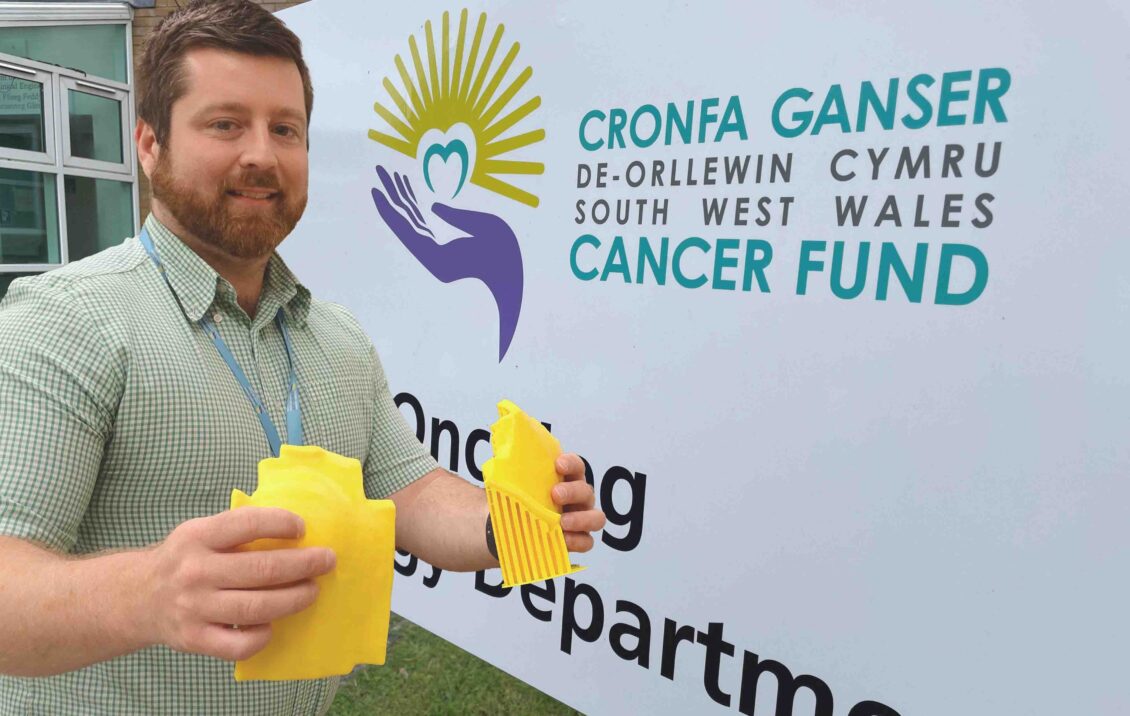
3D printing is providing an even higher quality of care for cancer patients undergoing radiotherapy at Swansea’s Singleton Hospital.
It is being used to create boluses, accessories that ensure the optimum dose of radiotherapy for cancers close to the surface of the head or neck.
Not only is this better for patients, but it is also saving radiotherapy staff time, freeing them up to do other important work.
For most types of radiotherapy to the head or neck, patients wear a mask, sometimes called a shell.
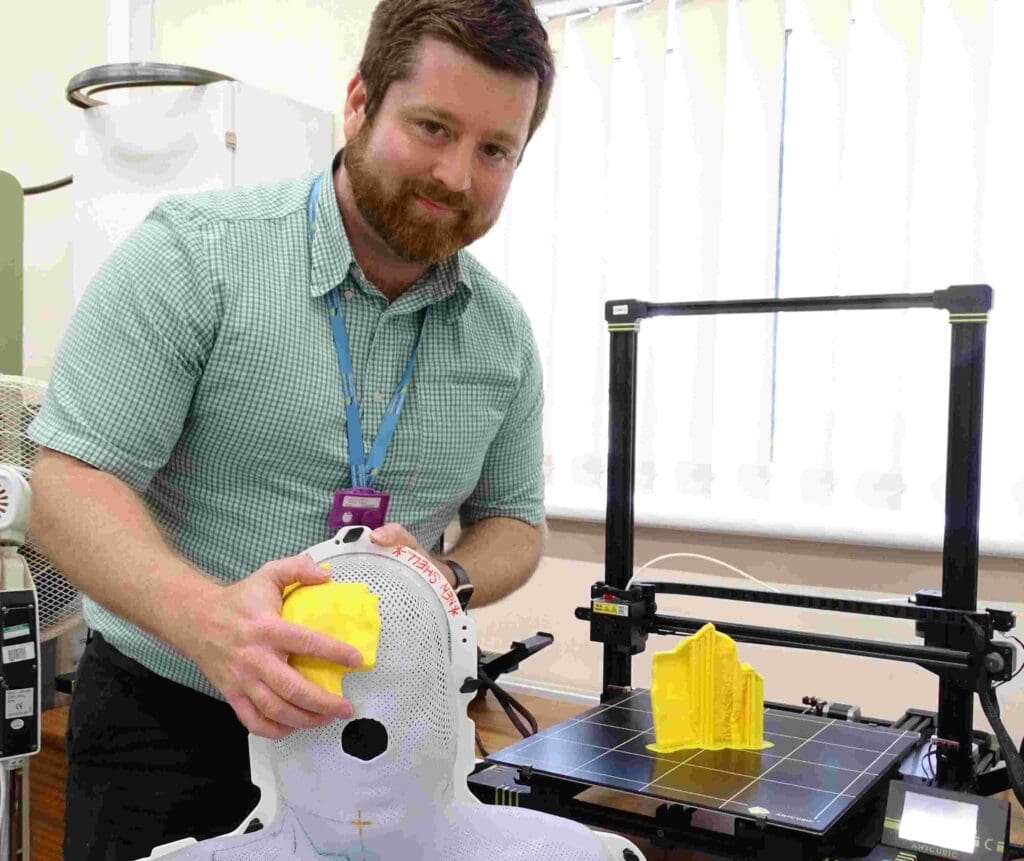
It is made of thermoplastic, which is warmed and moulded to follow the exact contours of their skin. The shell holds their head and neck still and in the right position for the most accurate, effective treatment.
However, for some cancers a bolus is required to provide an additional layer during radiotherapy. Previously these were made out of moulded wax and had to be fitted to the mask by hand.
But this was time-consuming and far from perfect as there could be gaps left between the bolus and mask. Now the investment in a 3D printer means the bolus can be created literally at the press of a button.
The idea originally came from advanced radiotherapy physics technologist Rhys Jenkins after he read about it in a professional magazine.
“When the photons used in radiotherapy enter the skin, they do not provide 100 per cent of the dose straight away,” explained Rhys, who is based at the South West Wales Cancer Centre in Singleton.
“Instead, there is a build-up effect. For skin cancer or other superficial head and neck cancers, such as those of the parotid gland, which are close to the skin, this build-up would happen deeper, and we would miss quite a bit of the target with the required dose.
“So, the bolus acts like tissue material. The build-up happens there, so by the time it gets to the patient’s skin it has reached the dosage you want.”
The shape, depth and positioning of the bolus is all designed during the treatment planning stage. Until recently it had to be hand-formed from wax, taking anything up to an hour to make.
However, this could leave air gaps. And as the bolus had to be manually pushed into place, there was no guarantee it was the same shape as that designed on the planning system.
There were other drawbacks too. Sometimes the bolus would be dropped, or the brittle wax would crack, and another would have to be created.
The investment in a 3D printer has changed all that. It was introduced with the support of Swansea Bay’s maxillofacial laboratory team, who have had extensive experience of using 3D technology over many years.
“They helped us decide on what printer to buy and helped us get set up as well,” said Rhys. “So, we have developed our own in-house service.
“We just create the bolus on the treatment planning system and then the printer basically prints exactly what we designed. As it is an exact copy of what we want, it fits onto the shell like a jigsaw piece.
“The main advantage is the improved accuracy and improved confidence that what we have planned on the system is in the exact same place.
“Because, with the old method, forgetting all the air gaps, we were not that confident in how we were positioning it as well. There were so many steps where errors could be introduced, but this has negated most of them.
“We’ve reduced staff time as well, so we have made the process a lot more efficient.
“Some of these boluses take one to two days to print. But that’s not staff time. We just set it to go ahead and then come back when it is finished, and it frees up your time for other things.”
Senior radiographer Catherine Davies said the move to 3D printed boluses had been a positive step for patients and for staff.
“For staff, this bolus is easier and quicker to fit, is unbreakable and is shown on our daily patient scans to adhere perfectly to where it is intended – and stays there,” she added.
“Patients benefit from the quicker application as they are on the bed for that little bit less.
“They also tell us they do not feel it being placed on the treatment shell, as this new type of bolus does not require moulding to the shell.”
Singleton-based consultant clinical oncologist Russell Banner said the team at the South West Wales Cancer Centre had always used innovative solutions to improve patient care.
“The 3D printing has enabled highly accurate and quality assured boluses to be produced from 3D planning scans, minimising uncertainty and bringing the dose to exactly where we need it,” he said.
“The printer even prints overnight while we are sleeping to ensure there are no delays in the treatment pathway.”
