

A new radar being built in Scandinavia will be used by researchers at Aberystwyth University to capture three-dimensional measurements of the Northern Lights for the very first time.
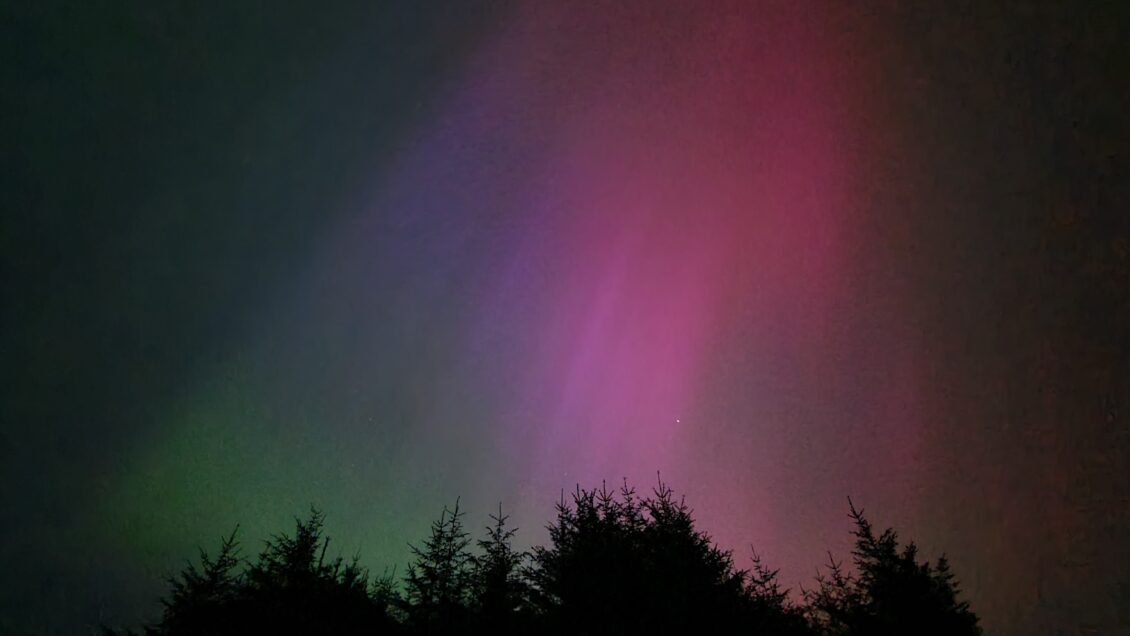
Dramatic pictures of the Northern Lights (aurora borealis) were recently captured across the UK as a significant solar storm struck the Earth’s atmosphere.
Space weather forecasters are predicting similar scenes later this week and over the coming months as the Sun nears the most active phase of its eleven-year cycle, the Solar Maximum.
Located on three sites across Norway, Sweden and Finland, the new radar array EISCAT_3D is due for completion later this year.
Dr Rosie Johnson, an academic at Aberystwyth University’s Department of Physics whose research area focuses on auroras, will be using the equipment to study the ionosphere, the outer layer of the Earth’s atmosphere.
Starting from around 70 to 90 kilometres above the Earth and extending out into space, the ionosphere, combined with the Earth’s magnetic field, protects the planet by absorbing and deflecting harmful radiation from the Sun.
Dr Johnson said: “The ionosphere is complex and changes constantly from day to day due to variations in space weather conditions. Even small changes in the ionosphere can scatter radio waves from satellites interrupting communications and GPS that society is becoming increasingly reliant on. Our focus will be to use the unprecedented resolution of EISCAT_3D to understand the small-scale changes of the ionosphere and the impact of this on technological systems.”
An aurora is formed when charged particles from the Sun, which are trapped by the Earth’s magnetic field, stream down into the polar regions and hit oxygen particles in the Ionosphere, which then give off a green light as they try to rid themselves of this excess energy.

Dr Johnson added: “At lower energy levels the oxygen particles will produce red light. The nitrogen in the ionosphere produces purple light, which can combine with the other colours of the aurora to create shades of pink and orange. It is these reactions that create what we see as the Northern Lights.”
According to Dr Johnson, who featured in the BBC’s Spectacular Earth series, the colours that are seen will also depend on where the aurora is viewed.
“Those who saw the aurora in the UK recently will have noticed more red overhead, which occurs high up in the atmosphere. Further north, the same aurora would have appeared more green overhead as the green emission occurs much lower in the atmosphere.”
Dr Johnson’s current research is focused on the aurora on Jupiter, which has a magnetic field 20,000 times stronger than Earth and is five times further away from the Sun.
Using the NASA Infrared Telescope Facility on Hawaii, she has been studying the effects of the solar wind on Jupiter’s atmosphere.
Jupiter’s atmosphere is mainly hydrogen and its incredibly strong magnetic field combined with the planet’s fast rotation and volcanic moon plasma source means its aurora is the most powerful in the solar system.
Her work is focused on understanding how the solar wind and the aurora on Jupiter are connected and whether it is similar to what happens on Earth.
“Jupiter offers us a laboratory in space to study the aurora in a different context. Normally in a laboratory you can change the experiment, but in this case, changing the experiment means changing planet”, added Dr Johnson.
“We know the solar wind impacts the Earth’s aurora, but on Jupiter, it isn’t clear how the solar wind and the aurora are connected. No one has settled on a definitive answer. Auroras exist across the solar system and have been seen on Venus, Mars, Saturn and Uranus. This work will help us to understand the connection between the Sun and the planets and whether what is happening on Jupiter is similar to Earth. Hopefully it will also help us to better understand our own planet.”
Dr Johnson’s study using the EISCAT_3D radar array is funded by UKRI’s Natural Environment Research Council.
EISCAT, the Sun and Aberystwyth
Established in 1975, the EISCAT (European Incoherent SCATter) international radar facility has been central in research at the Department of Physics, Aberystwyth University. The facility is used to study the high-latitude ionised atmosphere and signatures of space weather processes.
Aberystwyth involvement started in the early days of the facility. Sir Granville Beynon FRS (1914-1996) served as Chairman of the EISCAT Council, and Professor Phil Williams (1939-2003) was seconded as the Scientific Director of EISCAT in the early 1980s. The original facility comprised a radar system in northern mainland Scandinavia.
The ESR (EISCAT Svalbard radar) was later installed nearer to the north pole on Svalbard. Several staff members and research students at the Department used the systems to study the auroral and polar ionosphere and its irregular structure, and to investigate the solar wind and its effects of our near-space environment (Dr Andy Breen, Professor Len Kersley, Professor Eleri Pryse and Professor Phil Williams). The observations were often coordinated with those of other instruments in international collaborative studies.
Aberystwyth undergraduate students have had experience of the ESR radar during placement opportunities at UNIS (University Centre in Svalbard). The international radar facility continues to develop with the EISCAT 3D phased-array system, and Aberystwyth University participates through the collaborative UK FINESSE project funded by NERC.
In 2007 Dr Andy Breen and colleagues produced the world’s first 3D image of the Sun from data collected by NASA’s Stereo mission.
