

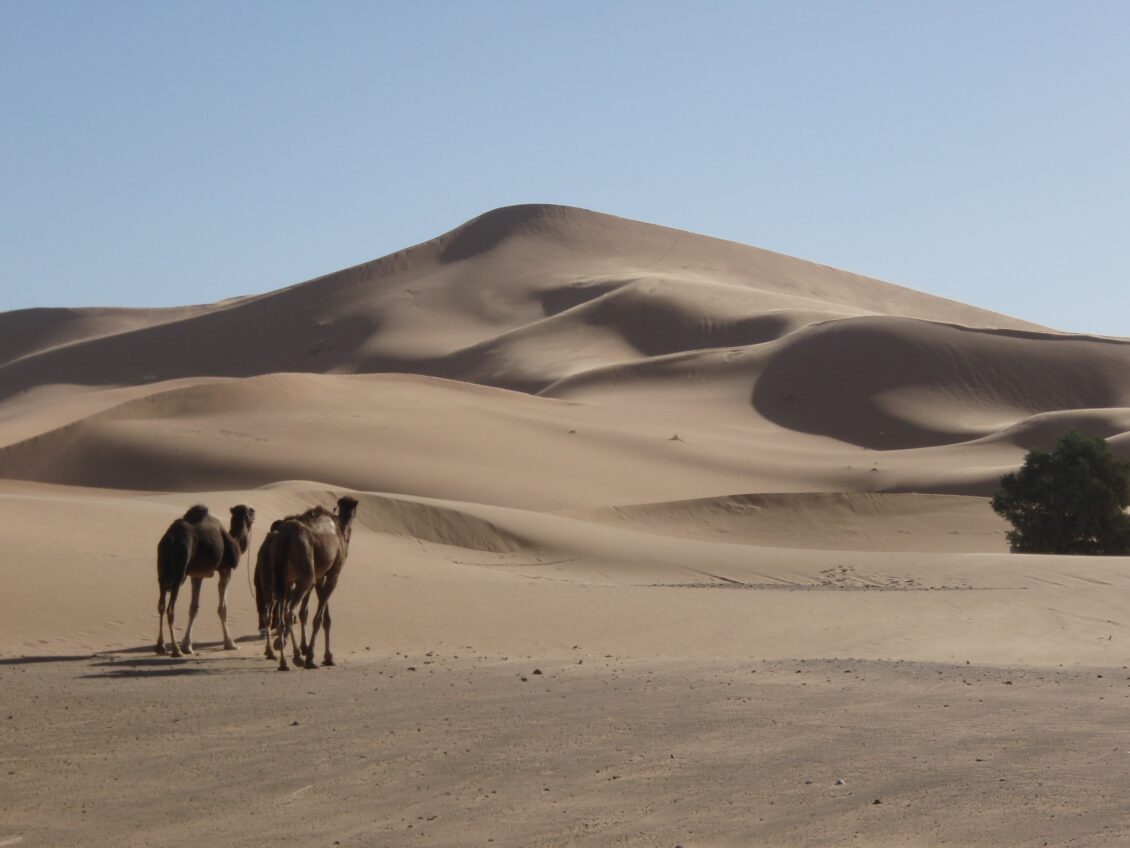
Scientists have solved the mysterious absence of star-shaped dunes from Earth’s geological history for the first time, dating one back thousands of years.
The study by Aberystwyth University, Birkbeck and UCL academics is the first to date how long it took a star dune to form and examine its internal structure.
Star dunes are massive sand dunes which owe their name to arms that spread from a central peak. These sand pyramids, which look like stars when viewed from above, are widespread in modern deserts including sand seas in Africa, Arabia, China, and North America.
The research reveals the oldest parts of the base of the Moroccan dune are 13,000 years old. However, the discovery that it had formed rapidly in the last thousand years surprised scientists who had thought larger dunes were far older.
Believed to be the tallest dunes on Earth – with one in the Badain Jaran Desert in China reaching 300 metres high – star dunes are also found elsewhere in the solar system, on Mars and on Saturn’s moon Titan.
Despite being common today, star dunes have almost never been found in the geological record. Their absence has bemused scientists as past deserts are a common part of the history of Earth, preserved in rocks deep underground.
Published in the journal Scientific Reports, the new study dated the foundations of a star dune in the southeast of Morocco known as Lala Lallia, meaning ‘highest sacred point’ in the Berber language, to around 13,000 years old.
The dune sits in the Erg Chebbi area of the Sahara Desert close to the border with Algeria, an area featured in TV series like SAS Rogue Heroes and blockbuster films such as The Mummy and Sahara.
The research shows that the sand pyramid reached its current 100 metre height and 700 metre width due to rapid growth in the past thousand years as it shifted slowly to the west.
Professor Geoff Duller, from the Department of Geography and Earth Sciences at Aberystwyth University, said:
“This research is really the case of the missing sand dune – it had been a mystery why we could not see them in the geological record. It’s only because of new technology that we can now start to uncover their secrets.
“These findings will probably surprise a lot of people as we can see how quickly this enormous dune formed, and that it is moving across the desert at about 50 cm a year. These fantastic star dunes are one of the natural wonders of the world.”
Professor Charlie Bristow of Birkbeck and UCL added:
“Using ground penetrating radar to look inside this star dune has allowed us to show how these immense dunes form, and to develop a new model so geologists know better what to look for in the rock record to identify these amazing desert features.”
The scientists’ breakthrough research suggests the star dune formed at around the same time as the Younger Dryas event, an abrupt cooling period in Earth’s history. It also reveals that the dune stopped growing for a period of 8,000 years.
Pottery found at the site also suggests wetter conditions, perhaps an enlarged monsoon, that stabilised the dune before the onset of a great drought.
The study used luminescence dating techniques developed at Aberystwyth University to discover the last time minerals in the sand were exposed to sunlight to determine their age.
Professor Duller of Aberystwyth University added:
“It’s quite a privilege to think that the luminescence dating techniques developed here in Aberystwyth are unlocking some of the secrets of the most challenging climates in the world. They are giving us an insight into geology that could have wider implications including geological deposits that are used for water resources and storing carbon.”
Professor Duller’s latest discovery uses the same luminescent dating technique he used to discover the oldest wooden structure in the world – research published in the journal Nature last year.
