

Welsh businesses saw a further rise in output during June, according to the latest Cymru Growth Tracker data from NatWest, but growth in activity slowed despite a sharper upturn in new sales.
At 50.5 in June, the headline Wales Business Activity Index – a seasonally adjusted index that measures the month-on-month change in the combined output of the region’s manufacturing and service sectors – fell from 51.5 in May, to signal only a slight expansion in output at Welsh private sector firms.
Meanwhile, the rate of increase in new orders accelerated to the sharpest in over two years. Despite more favourable demand conditions, firms were less confident in the outlook for output over the coming year and registered another strong fall in employment.
On the price front, input costs and output charges increased at softer rates in June. Although still historically elevated, output prices rose at the weakest pace since October 2024.
Jessica Shipman, Chair, NatWest Cymru Regional Board, said:
“Business conditions appear to be improving for Welsh firms, as new order growth accelerated to the fastest in over two years and companies raised their output levels in turn. That said, the rise in activity was only slight. At the same time, previous hikes to the Minimum Wage and National Insurance contributions continued to weigh on business decisions as employment contracted again and confidence in the outlook was dampened amid concerns regarding client spending, and efforts to control costs.
“Inflationary pressures eased further from the recent highs seen in April, meanwhile. In a bid to drive sales, selling prices rose at the weakest rate since last October, as firms noted prioritising competitiveness over protecting their margins. In fact, of the 12 monitored UK nations and areas, only Yorkshire & Humber recorded a slower uptick in charges.”
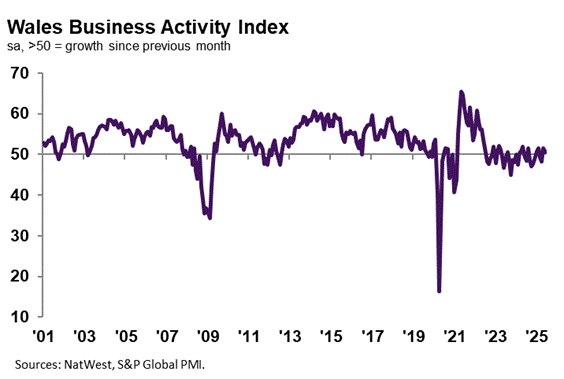
Performance in relation to UK
The rate of output growth was slower than the UK average. Anecdotal evidence suggested that stronger demand conditions supported the upturn, however.
Private sector firms in Wales signalled a second successive monthly expansion in new orders during June. The pace of growth quickened notably to the steepest in over two years. Moreover, the rise in new sales was the second-fastest of the 12 monitored UK nations and regions (behind the East of England).
As well as being below the long-run series average, the level of optimism was the second-weakest of the 12 monitored UK nations and areas, ahead of only the North East. Surveyed firms stated that customer uncertainty and reduced client spending weighed on positive sentiment.
A higher cost to employ staff following hikes to the Minimum Wage and National Insurance contributions reportedly led to cost-cutting initiatives and a reduction in headcounts. Of the 12 monitored UK nations and areas, Welsh firms recorded one of the sharpest drops in employment. The pace of job shedding eased, however, to the slowest since last November.
Despite a rise in new orders, firms were able to continue working through their backlogs during June. The rate of depletion was among the slowest in over a year, having softened from that seen in May. Nonetheless, the pace of decline was strong overall and quicker than the UK average.
Panellists mentioned that greater prices for raw materials and higher transportation fees coincided with the further impact of hikes in wage bills and labour costs on balance sheets. That said, the pace of input price inflation eased to the slowest in 2025 to date and was weaker than the UK average.
At the same time, the rate of increase in output charges softened as firms opted to remain competitive and drive new sales rather than protect margins. The pace of inflation was the least marked since October 2024. Moreover, of the 12 monitored UK nations and areas, only Yorkshire & Humber recorded a slower hike in output charges.
