

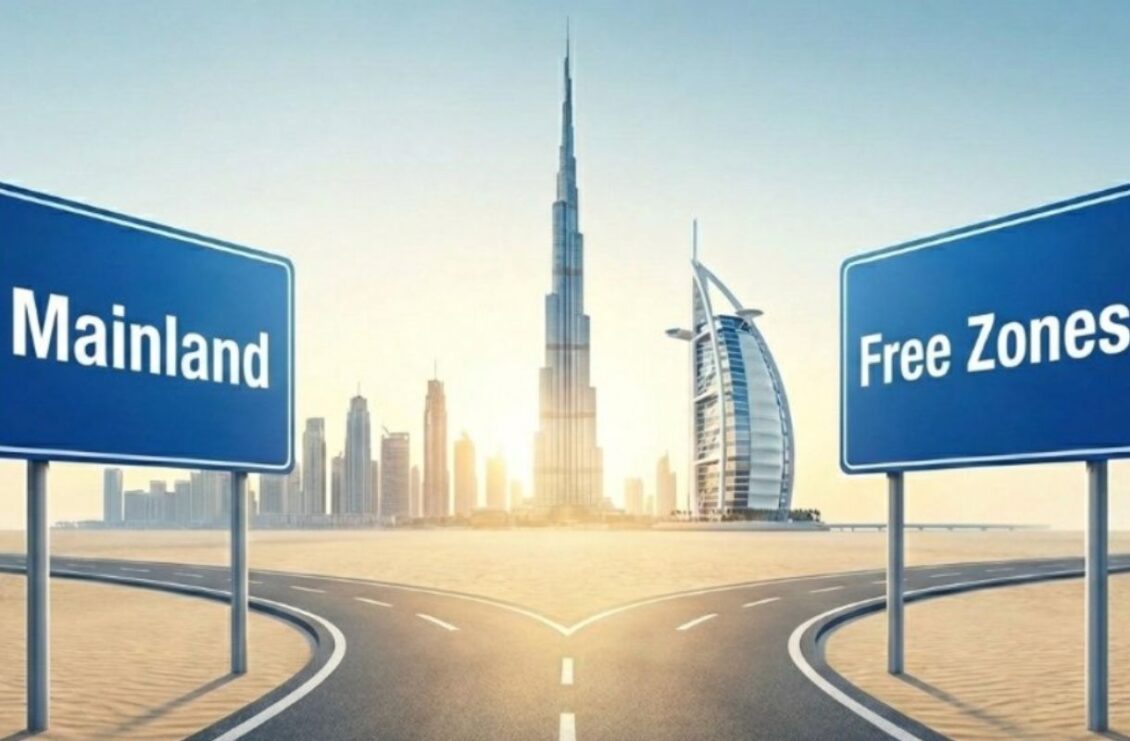
In 2026, the UAE business landscape has matured from an era of “zero tax” into a sophisticated “tax-optimized” global hub. With the Federal Decree-Law on Corporate Tax now in its third full year of implementation, the central question for foreign investors has shifted. It is no longer “How do I avoid tax?” but rather “Which structure offers the most strategic tax efficiency for my specific revenue model?”
Whether you are launching a startup or restructuring a multinational, the battle between Mainland and Free Zone jurisdictions has entered a high-stakes phase. This article analyzes the 2026 tax landscape to help you determine which structure “wins” the corporate tax game for your business.
1. The 2026 Corporate Tax Baseline
To understand the “game,” we must first define the rules. In 2026, the UAE continues to apply a standard 9% Corporate Tax on taxable profits exceeding AED 375,000. However, the nuances of how this tax is applied differ significantly between jurisdictions.
The Small Business Relief (SBR) Sunset
2026 is a pivotal year for SMEs. The Small Business Relief (SBR), which allows businesses with revenue below AED 3 million to claim “zero taxable income,” is currently slated for tax periods ending on or before December 31, 2026.
- The Strategic Move: If your business is on the Mainland and your revenue is under the threshold, 2026 is your final opportunity to benefit from this compliance-lite relief before standard 9% rules (or potential extensions) apply.
2. Mainland Strategy: Flexibility at a 9% Premium
A Mainland company, registered with the Department of Economy and Tourism (DET), is often seen as the “standard” choice. While it generally faces the 9% tax rate, it offers operational freedom that can outweigh the tax cost.
Why Mainland Wins on Operations:
- Unrestricted Trade: You can trade directly with any UAE-based consumer or government entity without a middleman.
- Global Portability: Easier access to government tenders and a wider range of physical office locations.
- No “Qualifying” Hurdles: Unlike Free Zones, you don’t need to worry if your activity is “qualifying” – your tax is a flat 9% on profit, period.
Tax Optimization on Mainland:
If you are looking at business setup in Dubai on the mainland, your “win” comes from deductions. In 2026, the FTA allows for robust deductions on salaries, interest expenses (up to 30% of EBITDA), and depreciation. For many service-based SMEs, these deductions can bring the effective tax rate well below 9%.
3. Free Zone Strategy: The “Qualifying” Gold Standard
Free Zones remain the jewel of the UAE’s tax system, offering a 0% Corporate Tax rate. However, in 2026, this 0% is no longer automatic. You must be a Qualifying Free Zone Person (QFZP).
Qualifying vs. Excluded Activities
To win the 0% tax game, your income must come from Qualifying Activities.
- Qualifying (0% Tax): Manufacturing, ship management, reinsurance, fund management, and the Trading of Qualifying Commodities (recently expanded in 2026 via Ministerial Decisions 229 and 230 to include processed metals and energy products).
- Excluded (9% Tax): Banking, insurance (retail), and most importantly, transactions with natural persons (B2C).
The “De Minimis” Rule: In 2026, a Free Zone company can earn a small amount of “non-qualifying” income without losing its 0% status on everything else, provided that income stays below 5% of total revenue or AED 5 million (whichever is lower).
4. The Hidden Cost: Audited Financial Statements
A major 2026 update that many investors overlook is the Mandatory Audit Requirement.
- Mainland: Generally, only companies with revenue exceeding AED 50 million are legally required to have audited financial statements for tax purposes.
- Free Zone (QFZP): To claim the 0% tax rate, every QFZP must have an annual audit, regardless of their revenue size.
If you are a small startup with AED 1 million in revenue, the cost of a high-quality audit may actually be higher than the 9% tax you would pay on the Mainland. This is why professional UAE corporate tax advisory is essential before you pick your jurisdiction.
5. Strategic Comparison: At a Glance
6. The Verdict: Who Wins in 2026?
The Mainland Wins If:
- You are a B2C business (Retail, F&B, Clinics).
- You want to bid for UAE Government contracts.
- Your profit is just above the AED 375,000 threshold (where the 9% tax is less than the cost of Free Zone compliance).
The Free Zone Wins If:
- You are a B2B Global Exporter or Trader.
- You perform High-Value Services (Fund management, Headquarter services) for international clients.
- You are an Industrial Manufacturer utilizing the new 2026 commodity trading rules.
Why the Free Zone is the 2026 Superior Choice
While the Mainland has recently allowed 100% foreign ownership in many sectors, the Free Zone remains the “Gold Standard” for several strategic reasons:
A. The QFZP “Lock-In”
Under the newest 2026 regulations (including Ministerial Decisions 229 and 230), the list of “Qualifying Activities” has been significantly expanded. Free Zone companies involved in Commodity Trading now benefit from 0% tax on a wider range of goods, including industrial chemicals and environmental commodities like carbon credits.
B. Customs & VAT Efficiency
If your business involves the movement of goods, Designated Free Zones act as “outside the state” for VAT purposes. This allows for:
- VAT-free storage and transshipment.
- Zero customs duties on re-exports.
- Cash-flow advantages by not having to pay and later reclaim VAT on international inventory.
C. Industry-Specific Ecosystems
Unlike the Mainland, which is a general jurisdiction, Free Zones like DMCC (Commodities), DIFC (Finance), and DWTC (Tech/AI) offer tailored regulations and networking that act as a “multiplier” for business growth.
Investor Checklist for 2026
Before finalizing your structure, ask your advisor these three questions:
- Does my activity fall under the 2026 “Qualifying Activity” list?
- Will my “Non-Qualifying” income stay under the 5% De Minimis limit?
- Is the cost of a mandatory audit lower than my potential 9% tax liability?
Managing these complexities requires a partner who understands the intersection of legal structure and tax law. Firms like Emifast provide the strategic oversight needed to ensure that your business isn’t just “registered,” but “tax-shielded” for the long term.
Frequently Asked Questions (FAQ)
Q: Can I change my Free Zone company to a Mainland company?
A: You cannot simply “convert” the license. You must set up a new Mainland entity and potentially transfer assets or staff, which requires careful tax planning to avoid “exit tax” implications.
Q: Does the 0% rate apply to my salary as a Free Zone owner?
A: There will be no personal income tax in the UAE in 2026. However, the salary expense you pay yourself must be at “Arm’s Length” (market rate) to be deductible for the company’s corporate tax calculation.
Q: Can a Free Zone company trade with the Mainland in 2026?
A: Yes, but it is a “taxable event.” Income from Mainland trade is generally subject to the 9% rate, though it can still be managed within the De Minimis 5% threshold to keep the rest of the company’s income at 0%.
