

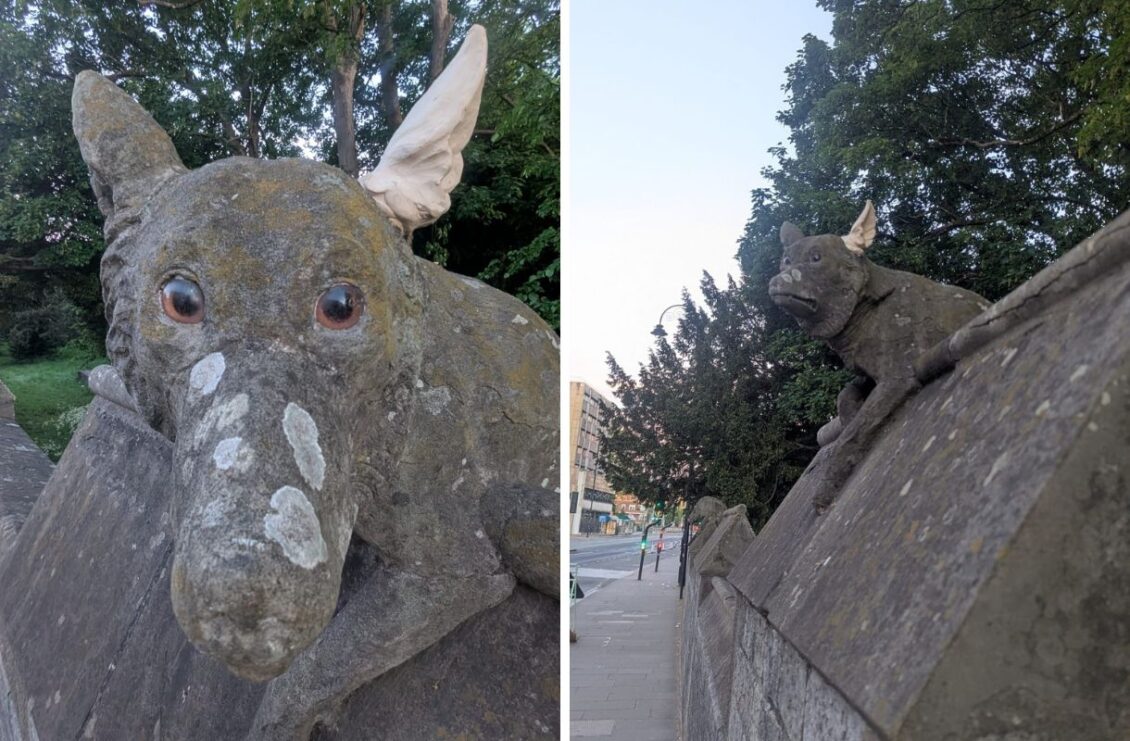
Conservation specialists are carrying out detailed restoration work on one of Cardiff’s most recognisable landmarks, the famous Animal Wall outside Cardiff Castle.
Cardiff Council has shared an update on the ongoing work taking place along Castle Street, where skilled craftsmen are currently repairing the wall’s wolf sculpture.
As part of the restoration, specialists have carefully modelled a replacement ear using clay, which has been temporarily fitted before being recreated in stone as part of the final repair process.
The much-loved Animal Wall has attracted attention from residents and visitors for generations and remains one of Cardiff’s most photographed landmarks.
The historic wall dates back to the late 1800s, when architect William Frame brought the designs to life using sketches created by renowned architect William Burges, who worked for the 3rd Marquess of Bute.
Originally constructed in the 1890s directly outside the castle grounds, the wall featured a collection of animal sculptures including lions, a lioness, a lynx, a bear, sea lion, wolf, apes and a hyena. These original carvings can still be identified today by their distinctive glass eyes.
In 1923, the wall was moved further west following the widening of Duke Street. During the relocation, six additional animals were added including a vulture, beaver, leopard, raccoons, pelican and an anteater.
Cardiff Council also revealed that models of each animal had to be approved by Lord Bute before construction, with two proposed creatures, including a sea horse, ultimately rejected.
The Animal Wall underwent major conservation work in 2010 as part of Bute Park’s wider restoration project. This included extensive cleaning and repairs to damaged stonework, while part of the wall near Cardiff Bridge was lowered to improve views into the park from Castle Street.
The latest work aims to preserve the landmark structure for future generations, with further updates expected as the intricate stone carving continues.
