

Understanding how fishing on the sea floor affects the amount of carbon which is stored in the seabed is currently one of the big topics in marine science.
Bangor University in collaboration with Imperial College London, Western Fish Producers Organisation, South Western Fish Producer Organisation and Centre for Environment Fisheries and Aquaculture Science (CEFAS) have looked into whether fishing on the seabed might lower the amount of carbon stored in it. This collaboration is funded from Department for Environment, Food & Rural Affairs (DEFRA) through FISP (Fisheries Industry Science Partnerships scheme).
Recent studies have warned that fishing on the sea floor could release carbon stored in the seabed and increase CO2 in the atmosphere. Human activities that affect the transfer of CO2 between the atmosphere into the oceans has relevance for efforts to understand climate change.
The research looked at sandy and gravelly seabed where beam trawls and scallop dredges are often used. These areas have not been studied as much as muddy seabed.
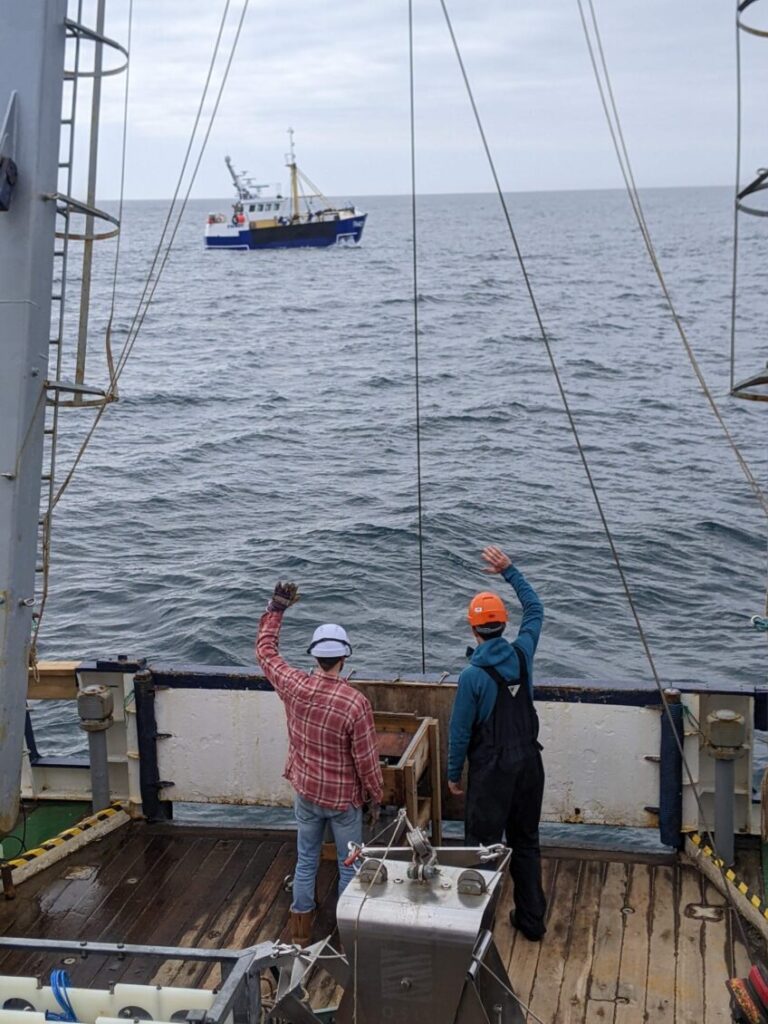
Bangor University’s own research ship called the Prince Madog was used to collect samples from the seabed and the water. They did this before and after two fishing boats fished with trawls and dredges for fish and scallops. This helped them find out if fishing changes how much carbon is in the seabed.
Dr Tim Whitton, Post-Doctoral Ecologist Researcher at Bangor University who was lead researcher on this project said:
“At the study site off southwest England, there was already very little organic carbon in the seabed. When fishing gear disturbed the seabed, it didn’t clearly reduce the amount of carbon in this short experiment. We found low levels of organic carbon in the top 5.5 cm of sea floor, where the fishing gear reached, even before any fishing took place. Our results didn’t show clear signs that fishing was removing carbon from the seabed or speeding up the breakdown of carbon immediately after in the water or in the days after fishing in the seabed. But longer studies are needed to fully understand the possible effects.”
Understanding the importance of the oceans in the carbon cycle, and the interaction between bottom fishing and seabed carbon storage has significant policy implications for seabed management and the fishing industry.
Western Fish Producers Organisation and South Western Fish Producer Organisation explain:
“Science-backed insights into seabed carbon dynamics are essential for evidence-based marine management.This collaborative research provides a strong foundation for policies that balance environmental sustainability with the realities of commercial fishing. As climate change drives shifts in fish distribution and broader ecosystem changes, the fishing industry remains committed to reducing its environmental footprint while ensuring long-term resilience.
By anchoring decisions in empirical data, we can develop balanced and effective management regimes that safeguard the long-term viability of our fishing fleets, which are fundamental to our national food security and thriving coastal communities.”
Bangor’s Professor Jan Hiddink who led this collaborative work is continuing research to increase the empirical data in this research area, said:
“We currently do not know enough about the impact of trawling on seabed carbon to make robust large-scale projections, but this project has helped to fill a gap in our understanding of the impact on coarser sediments. Future work needs to focus on the evaluation of both short- and long-term impacts of different trawl gears in different environments, before we can evaluate where and when bottom trawling may result in CO2 emissions to the atmosphere.”
