

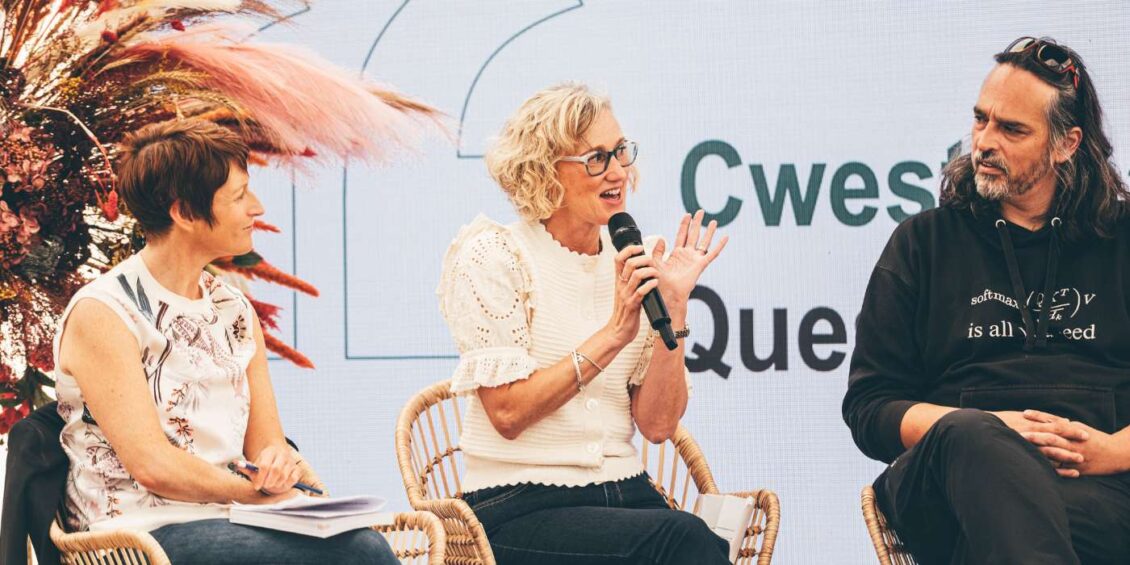
Digital public services are failing visually impaired users who want to access them in the Welsh language. This was the powerful message from Rob Williams during a panel event at the National Eisteddfod this week.
Hosted on the Welsh Government stand at the Eisteddfod, the event marked the launch of Access for All – a new book from the Centre for Digital Public Services (CDPS) and Cardiff University. The publication brings together real-life stories, global best practice, and practical guidance to support more accessible digital design in Wales.
Rob, from Wrexham, is registered blind and a first language Welsh speaker. He acknowledged improvements in digital accessibility in recent years but said the lack of suitable Welsh-language screen reader technology continues to shut people like him out of essential services.
He highlighted that very few people can afford to buy braille displays, which allow users to read on-screen content in braille. He also noted that Welsh screen readers currently available can only be used for reading long texts or stories, as they’re not suitable for essential day-to-day digital tasks.
“Government websites in English are generally accessible if they follow digital standards. But I’ve never been able to use public services in Welsh,” he said. “There’s no suitable Welsh-language technology that I’m aware of to help me navigate them, so I don’t know what’s available or how usable those services are. I can’t even text my family in Welsh, which is frustrating and makes me sad, as I’ve spoken Welsh to them all my life”
Rob added: “The feeling of relying on someone else to complete a simple task, not because of your disability but because it hasn’t been adapted, is horrible. It could mean missing out on vital support or benefits.”
As a Digital Skills Officer for Vision Support, Rob regularly works with older Welsh speakers who struggle with digital services, sometimes due to low digital literacy, but often because of language barriers. “Welsh-language helplines are often unavailable or just not to the same standard as the English ones,” he said. “We’re encouraged to go digital, but until accessible Welsh-language screen readers are developed, offline services must remain properly available.”
Welsh Language Commissioner Efa Gruffudd Jones was on the panel during the discussion at the Eisteddfod. Efa said: “It’s important to acknowledge that progress is being made in this field. The Language Technologies Unit at Canolfan Bedwyr, for example, is undertaking excellent work – leading the way in research and development in both text and speech technologies.
“That said, Rob’s story is a powerful reminder that there is much still to do. If we are to ensure that Welsh speakers can fully benefit from language technology, further investment and work is needed.”
CDPS recently ran a research project exploring the state of digital accessibility in Welsh public services. The research found some good practice, but also highlighted major challenges – including unclear enforcement of standards, a lack of in-house skills, and poor accessibility in many third-party supplier products.
Joanna Goodwin, Head of User Centered Design at CDPS, said: “Behind every product, every service, and every policy, there are real people affected by the decisions we make. The stories in our book, as well as Rob’s, challenge us to think differently, to listen more closely, and to design with empathy.
“When we do that, something remarkable happens. Take video captions. Originally designed for people with hearing impairments, they’re now used by anyone watching videos in noisy places, quiet offices, or while learning a new language. Designing for people with access needs improves the experience for everyone.
“The Digital Service Standard for Wales demands that we make sure everyone can use our services. This isn’t just policy, it’s a moral imperative rooted in the Well-being of Future Generations Act. Our new book, launching today with Cardiff University, is more than guidance – it’s a call to action.”
