

For us today, the established order on the road is nothing out of the ordinary; it’s part of our daily lives. But just for the sake of a thought experiment, imagine you’re driving along the Moscow Ring Road during rush hour when suddenly the traffic lights go out – and that’s it, a traffic jam. Or at a construction site in the Moscow region, a crane is lifting a slab, whilst the driver is in the cab 20 metres away from you. Other drivers start swerving in all directions, and chaos ensues. It is in such critical moments and dangerous situations on the road that gestures come to the rescue. No, this isn’t an outdated habit, because technology can let you down (broken brake lights, non-functioning indicators, traffic lights that suddenly go out) — it is gestures that can save lives. Russia has a highly developed road network; roads are often congested, round-the-clock roadworks are underway, and delivery robots are being tested, so it is important to know and understand this universal language of gestures. Let’s take a look at how it works in real life.For further information on gestures, please visit the website Signs-en com.
Traffic warden gestures
If we look at section 6.10 of the Highway Code, we see that it states: signals from a traffic warden take precedence over traffic lights, road signs and road markings. A traffic warden is a living ‘traffic light’ in uniform. They use three basic hand positions (plus a baton for visibility):
- A hand raised upwards means ‘stop all traffic’. In other words, neither vehicles nor pedestrians are allowed to move, except those already in the middle of a manoeuvre. This gesture can quickly prevent accidents if a traffic light unexpectedly breaks down.
- Arms extended to the sides or lowered — if this gesture is made at chest level, it means that movement is prohibited; if the arms are extended straight out, it means that straight-ahead passage is permitted; if the arm points to the right or left, it means that you may turn in that direction.
- Right arm extended forwards — this means that from the left-hand side, you may proceed in all directions; from the chest, only to the right.
The traffic warden also gives other hand signals: twisting the baton (speed up), or swinging the baton sharply downwards (complete the turn). If there is an emergency on the road or a mass event taking place, the traffic warden literally saves road users.
Coordination at construction and freight sites
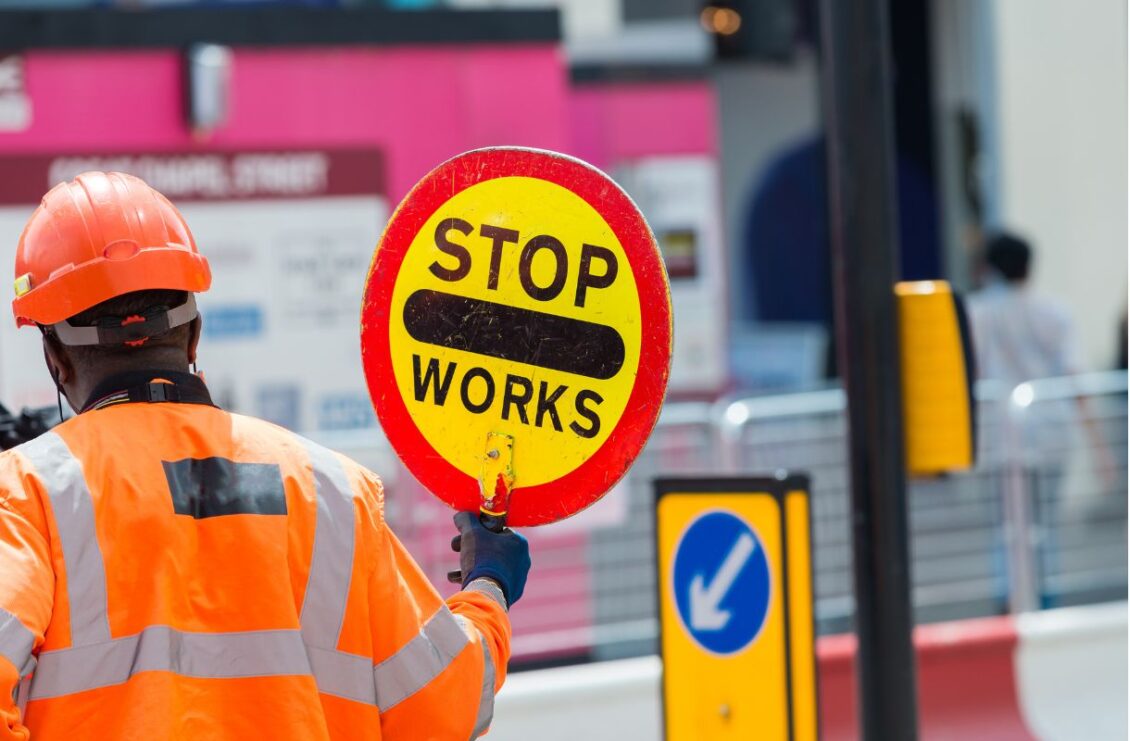
Clear sign language is also used at construction sites or freight terminals. Shouting in such places is pointless; the high noise level will prevent you from understanding what a worker is shouting at you the first time round, and at such sites it is very dangerous to neglect establishing adequate and universally understandable communication. In these cases, everyone uses the standardised rigger’s language (in accordance with GOST 34591-2019 and the old RD 10-107-96 standards). The signalman, wearing a high-visibility vest, stands so that the crane operator can see him clearly, and gives commands with his hands:
- Stop — palm at chest level, making sharp movements from left to right.
- Lift — arm raised upwards, making circular movements with the index finger.
- Lower — arm lowered downwards, making circular movements.
- Caution — both palms at the crane operator’s chest level.
This universal language is used at all major Russian construction sites — from the reconstruction of federal highways under the national ‘Safe, High-Quality Roads’ project to the construction of bridges and residential complexes. One wrong move or a misinterpreted command and a giant slab could fall. That is why riggers undergo compulsory training: without these gestures, they simply cannot work on site.
Communication between drivers
Any experienced motorist will tell you that on the road, gestures sometimes speak louder and clearer than words. In Russian culture, a whole alphabet has developed that drivers understand without words:
- A raised palm above the steering wheel or hazard lights — ‘thank you, you let me through’.
- An open palm facing upwards — ‘give way’.
- A chopping motion with the palm — ‘boot is open’.
- A circle with a finger in the air — ‘you’ve got a flat tyre’.
Long-distance lorry drivers also often thank their fellow drivers by flashing their full-beam headlights or raising a palm upwards.
Prospects: gestures in driverless cars
The use of driverless vehicles for peaceful purposes is no longer science fiction, but part of our real life. In China, such systems are being trained to recognise gestures. Yandex is also collecting huge datasets on pedestrian movement and can already recognise people’s intentions based on their posture and gaze. Experts expect that in 7–10 years, driverless autonomous taxis will be a common sight on the roads; it is assumed that their firmware will include a gesture recognition function. This should make the roads even safer.
Significance for safety
In real life, sign language is used more often than it might seem at first glance. Most people think it is the preserve of traffic wardens and riggers on construction sites, but in reality, gestures have quietly become a feature of everyday life.
Gestures on construction sites are included in GOST standards; they help coordinate the work of machinery and people. Traffic police officers manually direct traffic after an accident or when traffic lights are out, and even in normal traffic flow: lorry drivers, drivers in traffic jams and pedestrians ‘talk’ without words.
Nowadays, gesture recognition is being integrated into drones, and Yandex plans to train robotaxis to recognise traffic controllers’ signals. Thus, the gesture system acts as a backup safety system in the event of various emergencies: power or internet outages, unpredictable weather, technical faults in other equipment, and so on.The more people who understand universal gestures, the safer our roads will become.
