

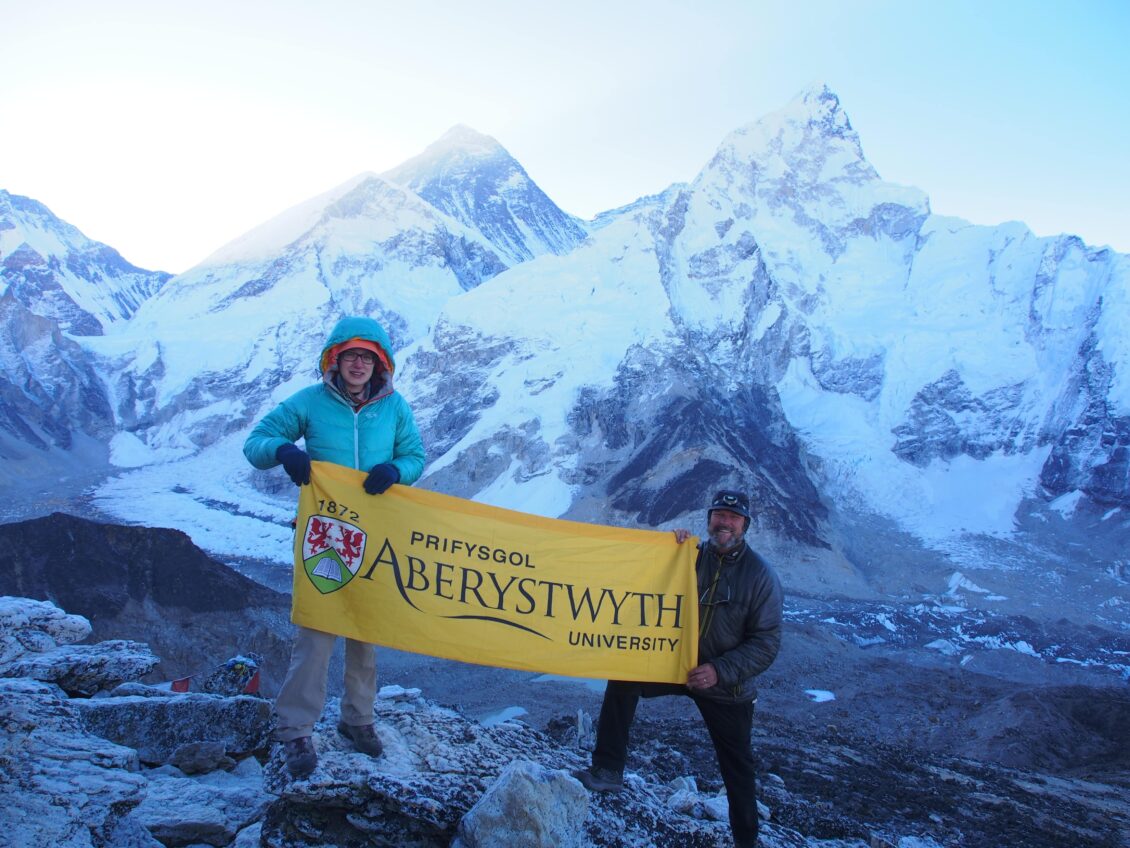
Researchers plan to test if the snow high up on Everest is melting, threatening the water supplies of over one billion people.
Despite air temperatures being well below zero on the highest mountain on Earth, it is believed that the snow may be melting due to rising air temperatures combined with intense solar radiation.
If the theory proves correct, it would suggest that the glaciers in the Himalayas are thawing faster than expected.
Glaciers in the highest mountains of the planet are an extremely important source of water with over one billion people – including many in India, Pakistan and Bangladesh – depending on Himalayan runoff.
Changes in the rate of glacier thawing would threaten this water supply. Another danger would also be more flooding from failures of natural ice dams, or so-called Glacial Lake Outburst Floods.
The new project follows previous findings by Aberystwyth University and University of Leeds researchers which showed that the temperature of the ice in the lower parts of Khumbu Glacier, at the foot of Mount Everest, is warmer than would be expected given the local air temperature.
As part of the research, Professor Bryn Hubbard from Aberystwyth University will work with Professor Duncan Quincey of the University of Leeds to lead a team to the Western Cwm, over six kilometres above sea level and half a kilometre above base camp.
The researchers expect to go on their first trip in spring 2025 to drill into the surface of the upper reaches of Khumbu Glacier and use the boreholes to record temperatures. The team will also install automatic weather stations at the study sites.
This data will help them look for evidence of melting and refreezing within the glacier’s surface snowpack.
Professor Bryn Hubbard from Aberystwyth University’s Department of Geography and Earth Sciences said:
“It may well be a bit of a surprise to many that snow is melting within the mountain’s Western Cwm, but it is increasingly likely and it needs to be investigated and measured if we are going to be able to identify the effects of climate change on this water-stressed region and beyond.
“Understanding and recording what actually happens inside these glaciers is critical to developing computer models of their response to anticipated climate change. Equally important is developing a better understanding of how they flow so that we can better predict when dams that form on these glaciers are likely to be breached, releasing destructive volumes of water to the valleys below. This is a real risk in the Himalayas as it is in other regions such as the Andes and has the potential to endanger the lives of thousands of people.”
Scientific observations are rarely made at high altitudes because of the logistical challenges in transporting equipment.
The team is designing a new lightweight drilling setup to overcome these barriers. However, it will still face problems such as maintaining battery power in freezing temperatures and working in areas with harsh living conditions and low levels of oxygen.
Professor Duncan Quincey explained:
“Our previous work has relied on helicopters to transport our equipment onto the glacier, but given how thin the air is in the Western Cwm, we can’t be sure the helicopters will be able to fly this time. We also won’t know quite how the equipment will fare in such harsh conditions, because it is designed to operate in much warmer conditions – as could also be said for the human body! But if we can successfully drill even a single borehole within the Western Cwm, that will be a major success. Most importantly, it will lead us to being able to model how water supplies are likely to change for a large part of the world’s population with much greater certainty.”
Professor Hubbard added:
“This work will also give us a new understanding of processes and changes that are relevant for all glaciers in similar settings world-wide. Hopefully, it will resolve outstanding debates about the possibility of net mass loss at the world’s highest elevations and indicate the extent to which other glaciers within the Himalayas may also contain unexpectedly warm ice.
“We should also be able to provide insights into a rarely observed cryospheric zone that can inform public policy on climate change. As part of this, we will be providing further evidence for supporting agencies such as the United Nation’s Development Programme, and the Nepalese government. This should help them prepare for, and mitigate against, a now inevitable change in meltwater supply as climatic changes continue to influence the region.”
The project is funded by the Natural Environment Research Council and is a collaboration between academics from Aberystwyth and Leeds universities.
