

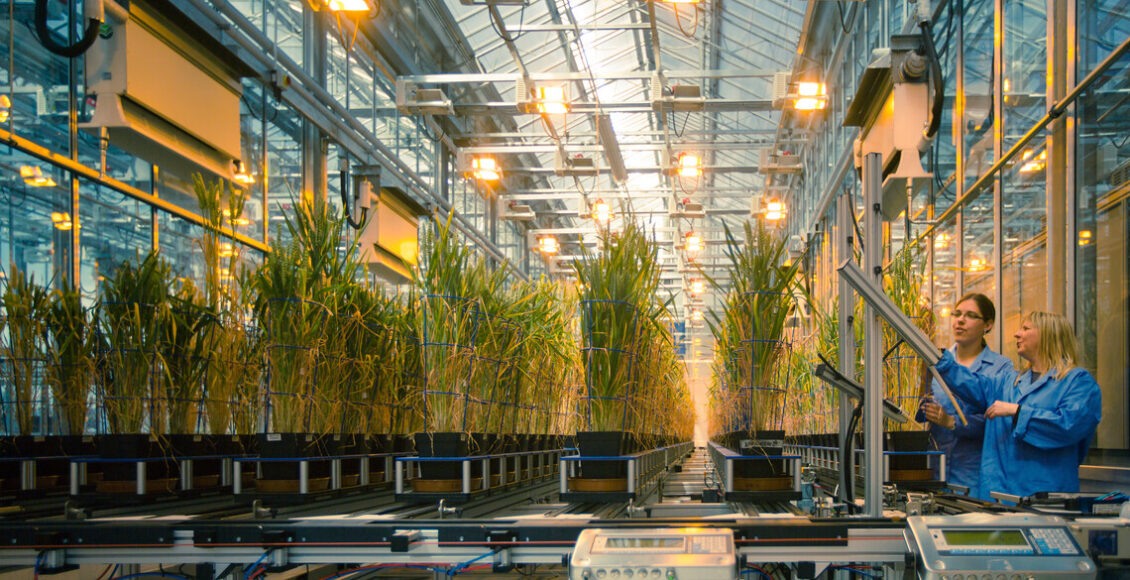
Scientists are aiming to unlock the potential of clover and other legumes to reduce the use of fertiliser and emissions from livestock agriculture, thanks to a £3.3 million UK Government grant.
To achieve the government net zero targets by 2050, greenhouse gas emissions from livestock farming need to fall by 78% by 2035. At the same time, the world’s population is forecast to reach 10 billion people by 2050, with demand for food predicted to rise by 70%.
UK sheep and cattle production relies predominately on grass-based pastures which use chemical nitrogen fertiliser to grow the grass used as feed for these livestock. Currently the process of manufacturing one tonne of chemical nitrogen fertiliser can release up to eight tonnes of carbon dioxide.
Clovers and other legumes can ‘fix’ their own nitrogen from the atmosphere and can share this with grasses growing in the same field.
As part of a new UK Government funded project in partnership with industry, scientists at IBERS, a research institute at Aberystwyth University, will look at the ability of red and white clover and another legume, Birdsfoot Trefoil, to improve the productivity of livestock whilst reducing reliance on chemical nitrogen fertiliser.
New legume varieties have been developed by Germinal and Aberystwyth University that are more resilient to grazing by cattle and sheep and extreme weather, due to climate change. Birdsfoot trefoil contains compounds called tannins, which can reduce methane emissions by cattle and sheep.
Researchers will be working with commercial farmers in the ‘NUE-Leg’ project to maximise its benefits. The project will look at how to best take advantage of the natural ability of legumes to fix nitrogen, reducing reliance on chemical nitrogen fertilisers.
The research will include on-farm trials to identify how to support farmers to reach net zero targets.
Dr Christina Marley from IBERS at Aberystwyth University said:
“This project could really help cut the use of fertilisers and agricultural emissions. The aim is to make the most of the ability of clovers and other legumes to increase nitrogen levels naturally in UK grasslands. We are really looking forward to working together with livestock farmers to understand how best to use these new legumes within real farming systems. There is so much potential in these adaptations to some of our native plants, as we, as a society, undertake a wider collective effort to tackle climate change”.
Welcoming the DEFRA Award on behalf of ‘NUE-Leg’ Project Partners, Mr. Paul Billings, Managing Director, Germinal UK & Ireland, said:
“Nitrogen is an essential nutrient for growing grass. Without it we could not grow the grass we need to feed our livestock and produce the dairy and meat products we need. However, nitrogen fertilisers are also a major source of greenhouse gas emissions in their manufacture and transport, and from in-field losses such as nitrous oxide and ammonia. They are also a source of nitrate losses to our waterways. They are expensive and farmers have seen huge volatility in prices, particularly in the last two years when price fluctuations have been around 300%.
“Governments around the world have rightly said that we need to reduce our reliance on nitrogen fertilisers. We need a solution. Legumes such as white and red clovers grown with grass can fix nitrogen from the air, but with no emissions. A current grass sward with a good clover content could fix on average between 100 and 150 kg of nitrogen per hectare per year. The clover will use about 75 kg of this for itself. The rest is available to the grass.
“But what if we could maximise the capacity of clovers to fix nitrogen by ensuring we have enough clovers that can persist in the sward, and match them with the right soil microbes and the right nutrition? We also need to wrap this up in a management approach that supports farmers and gives them the tools and information they need to make this work in a commercial setting, and make a profit.
“This is what we want to achieve with Project NUE-Leg. We want to achieve a threefold increase in the capacity of clovers to fix atmospheric nitrogen up to 300 kg nitrogen per hectare per year and thereby eliminate the need for chemical nitrogen fertilisers.
“This project has the potential to be truly transformative for grassland farming in the UK and globally. It could be a game-changer in both cutting emissions and in supporting farm profitability. In this context, we are very grateful to the UK Government for this funding award which allows this important project to proceed to its next on-farm testing and proving phase.”
The NUE-Leg research project is a partnership between Aberystwyth University, Germinal, Origin Enterprises, the James Hutton Institute, Agrecalc, Linking Environment and Farming (LEAF), Dovecote Farm, Pilgrim’s Pride, Müller UK & Ireland and the Centre for Innovation Excellence in Livestock (CIEL).
The project is funded by the UK Government’s Department for Environment, Food & Rural Affairs through the Farming Innovation Programme. The department is working in partnership with Innovate UK who is delivering the programme.
