

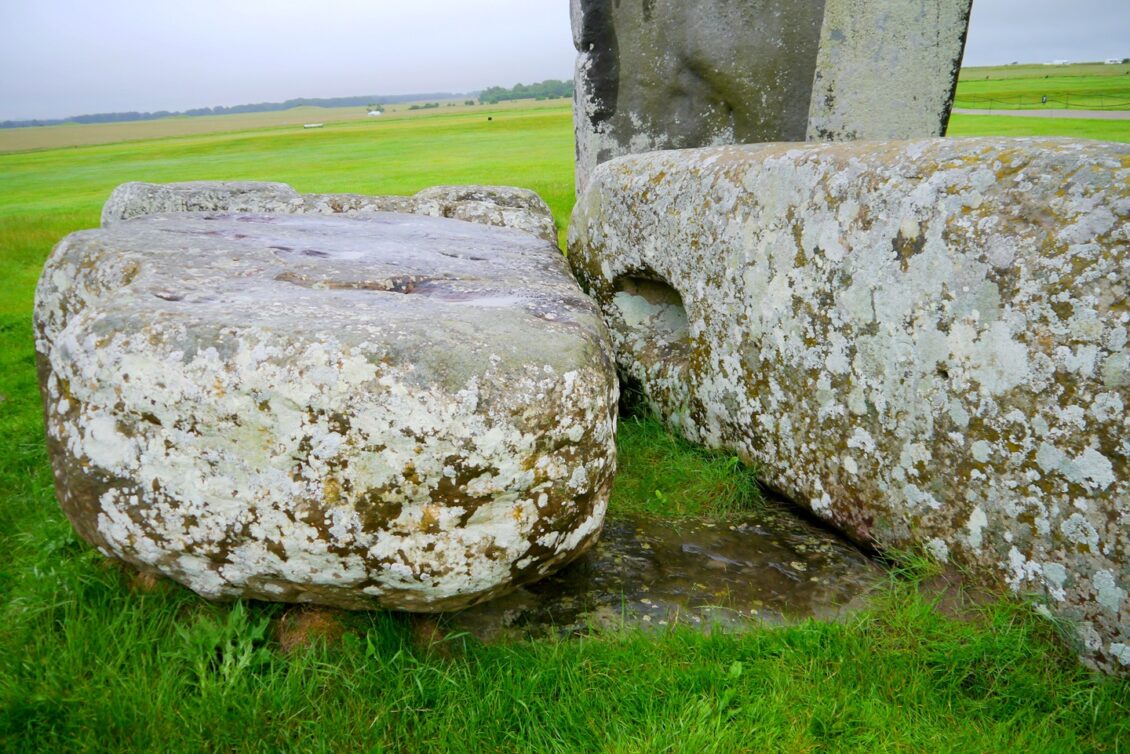
The recent discovery that one of Stonehenge’s stones originated in Scotland supports a theory that the stone circle was built as a monument to unite Britain’s early farmers nearly 5,000 years ago, according to a new study by researchers at UCL and Aberystwyth University.
In a research article published in the journal Archaeology International, academics analyse the significance of the recent discovery of the Scottish origin of the six-tonne Altar Stone, which confirmed that all of the stones that make up Stonehenge were brought to Salisbury Plain from many miles away.
In their new paper, the researchers say that Stonehenge’s long-distance links add weight to the theory that the Neolithic monument may have had some unifying purpose in ancient Britain.
Lead author Professor Mike Parker Pearson from the UCL Institute of Archaeology said: “The fact that all of its stones originated from distant regions, making it unique among over 900 stone circles in Britain, suggests that the stone circle may have had a political as well as a religious purpose – as a monument of unification for the peoples of Britain, celebrating their eternal links with their ancestors and the cosmos.”
Co-author Professor Richard Bevins of Aberystwyth University, said: “It’s really gratifying that our geological investigations can contribute to the archaeological research and the unfolding story as our knowledge has been improving so dramatically in just the last few years.
“Our research is like forensic science. We are a small team of earth scientists, each bringing their own area of expertise; it is this combination of skills that has allowed us to identify the sources of the bluestones, and now the Altar Stone.”
The study has been published (on 20 December) the day before the winter solstice, when the setting sun dips below the horizon over the middle of the Altar Stone and between the two largest upright stones (one of which is now fallen). During this winter period, Neolithic people feasted close to Stonehenge at the great village of Durrington Walls, and the midwinter solstice was probably central to these events.
Stonehenge is famous for these solar alignments on the solstice and even today attracts large crowds to the site on the shortest and longest days of the year. In addition, it was also the largest burial ground of its age. Some archaeologists think it might have been a religious temple, an ancient observatory and a solar calendar, and this new research adds a political dimension.
Professor Parker Pearson, a Professor of British Later Prehistory, added: “We’ve known for a while that people came from many different parts of Britain with their pigs and cattle to feast at Durrington Walls, and nearly half the people buried at Stonehenge had lived somewhere other than Salisbury Plain.
“The similarities in architecture and material culture between the Stonehenge area and northern Scotland now make more sense. It’s helped to solve the puzzle of why these distant places had more in common than we might have once thought.”
Stonehenge’s 43 ‘bluestones’ were brought from the Preseli Hills in west Wales some 140 miles away, while the larger ‘Sarsen’ stones were hauled from their sources at least 15 miles away to the north and east of the stone circle.
Transporting these massive monoliths was an extraordinary feat. Although the wheel had been invented, it had not yet reached Britain so moving these massive stones must have required the efforts of hundreds if not thousands of people.
The researchers point to how Stonehenge’s horizontal Altar Stone is similar in size and placement to the large, horizontal stones of the stone circles of northeast Scotland, where the Altar Stone originated.
These ‘recumbent stone circles’ are found only in that part of Scotland and not in the rest of Britain, so there may have been close ties between the two regions. Megalithic stones had ancestral significance, binding people to place and origins. The Altar Stone may have been brought as a gift from the people of northern Scotland to represent some form of alliance or collaboration.
It is difficult to pin down a precise date when the Scottish Altar Stone was brought to Stonehenge, but it probably arrived around 2500 BCE around the time that Stonehenge was remodelled from its original form.
This is the timeframe when the Neolithic builders erected the large sarsen stones forming an outer circle and the inner horseshoe of trilithons – paired upright stones connected by horizontal ‘lintels’ – that is present today. The Altar Stone lies at the foot of the largest trilithon, which frames the midwinter solstice sunset to the southwest. This was the second stage of construction at Stonehenge, long after the first stage (around 3000 BCE) when it is thought the bluestones from Wales were erected.
This second iteration of Stonehenge was built at a time of increasing contact between the people of Britain and arrivals from Europe, mainly from what are today the Netherlands and Germany. The researchers suggest that this period of contact may have been what spurred this second-stage rebuilding, and the monument was a reaction to these newcomers meant to unite indigenous Britons.
The new arrivals brought with them knowledge of metalworking and the wheel and, over the next four hundred years, their descendants – known as the Beaker people on account of the distinctive pots they buried with their dead – gradually replaced the population of indigenous Britons, and people with this European ancestry became the dominant population across the island.
The geological research was supported by the Leverhulme Trust.
