


The couple with ambitious plans to renovate a well-loved country estate in North Wales have discovered a number of new historic finds.
Andrew and Louisa Godfrey bought the Pool Park Estate near Ruthin in November 2023 and are on a mission to restore the crumbling Grade II listed building and its grounds.
Once a deer park belonging to nearby Ruthin Castle, Pool Park Estate was thought to have been established in the 16th century and rebuilt by William Bagot, 2nd Lord Bagot in 1826-1829 to the designs of John Buckler, and assisted by local architect Benjamin Gummow.
Over the past two years, Andrew and Louisa have discovered life-sized wooden angels which would have stood at the bottom of the grand staircase, an Edwardian pleasure walk hidden in the tangled undergrowth and a Celtic throne that dates back to the 11th century.
They’ve found old stables full of carved oak, a Victorian tennis court and a 17th century sundial.
Now they have also discovered Lady Bagot’s original driveway, which she would have used to travel back to the house in her carriage. It had been hidden for decades under a dense growth of bushes and brambles.
They have also found a giant Copper Beech tree. Often called the ‘Queen of the Forest’ for its regal and enduring appearance, with the Oak the King, they are among the biggest trees in Britain.
Other discoveries include tracking down a lost piece of the sundial, lost gardens and the gardener’s bothy.
Louisa Godfrey said: “It’s very exciting to make these discoveries and we’re never sure what we’re going to unearth next.
“We’ve also found historic gardens that have been hidden for years under thick bracken. We’ve gently cut these back and sunlight has now hit the forest floor for the first time in decades. As a result, we’re seeing the gardens come back to life with an abundance of wildflowers and four-foot-high foxgloves. It’s a beautiful thing to see.
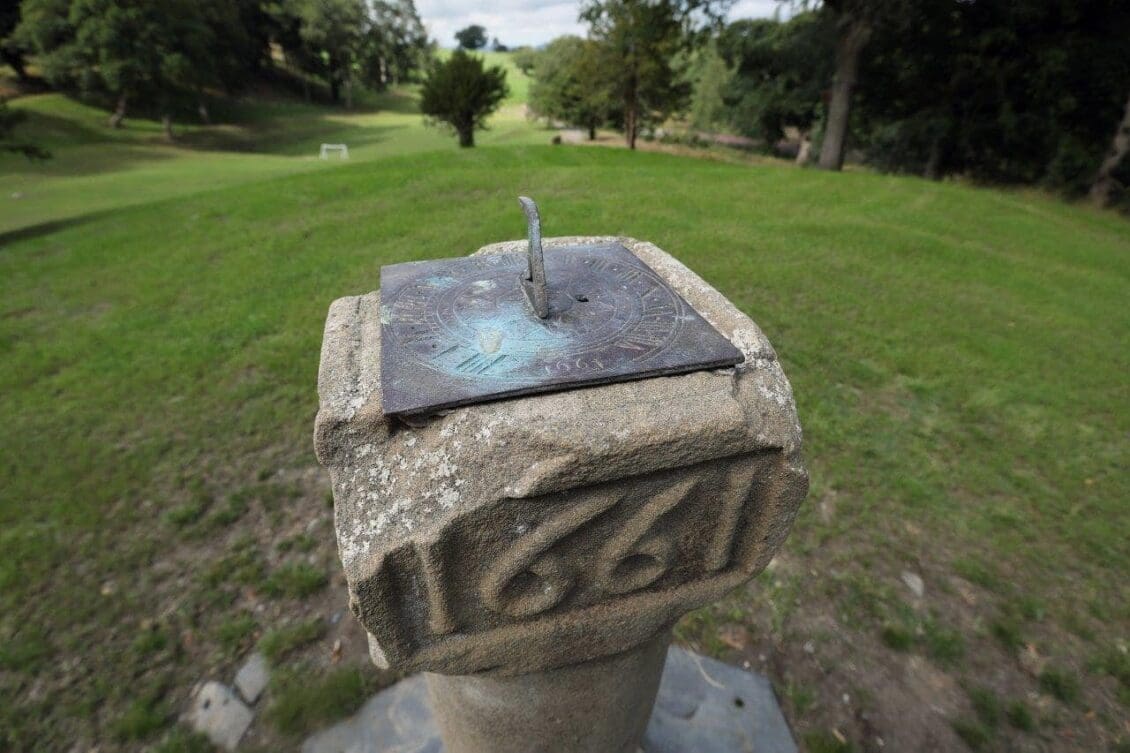
“We discovered the Estate’s 17th century sundial vandalised and buried in bramble last year and have spent time carefully restoring it. Amazingly we have tracked down the original plate from the top, which dates back to 1661, and have refitted it.
“After the house shut a lot of its contents went off to auctions and ended up in the Midlands. We spent ages online searching marketplaces for the original plate, which is such an unusual size, and were delighted when we found it. It fits perfectly and it’s lovely to see it back in its rightful place.
“On a historical country estate like this, the gardener would have worked in the walled kitchen garden which contained the main growing areas for food and flowers, and in the glasshouses used for plants like vines and fruit.
“The walled gardens here are magnificent, although desperately in need of repair, and we’ve found the gardener’s original bothy and a brick worked pathway he would have walked along every day.
“Every time we make discoveries like this it brings the Estate, and the people who lived and worked her, back to life in our minds. We think it’s vital for the local community that everything is done to restore and maintain this beautiful building and its grounds for future generations to love and enjoy.”
Once a deer park belonging to nearby Ruthin Castle, Pool Park Estate was thought to have been established in the 16th century and rebuilt by William Bagot, 2nd Lord Bagot in 1826-1829 to the designs of John Buckler, and assisted by local architect Benjamin Gummow.
The Bagot family lived at Blithfield Hall in Staffordshire and rented Pool Park to a series of tenants.
Until being rescued by Andrew and Louisa, Pool Park was last occupied as a home by Sir Ernest Tate, president of the sugar refiners Tate and Lyle.
