

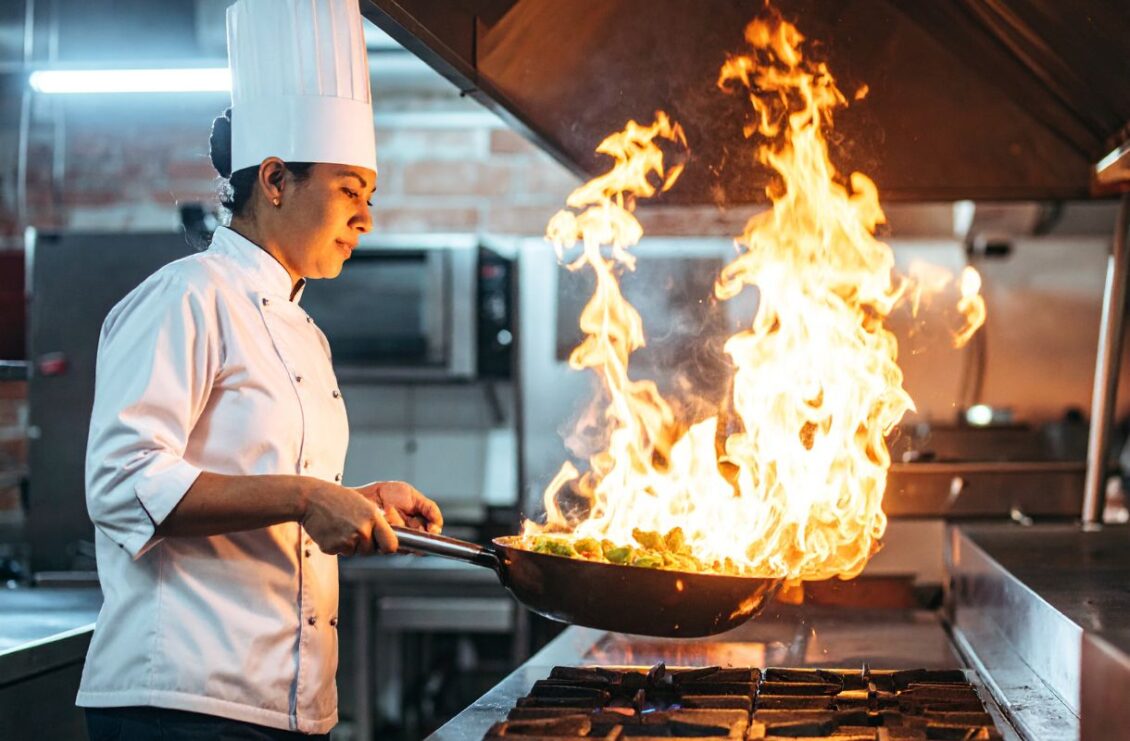
If you’re running any business that serves food, then your success will largely rest on what goes on in your kitchen. If your staff aren’t provided with the tools and the environment they need, then they might struggle to deliver consistent results. They might also end up suffering from unnecessary stress, and higher rates of absenteeism. This can be a vital consideration at certain times of year, like the run-up to Christmas.
So, what changes might you make to drive up productivity in the kitchen? There are a number of them to consider.
Streamline your layout and workflow
A good division of labour in the kitchen means having a sensible division of the space. When prep work starts to intrude on a space reserved for cookery, the efficacy of both will begin to drop.
Spend some time observing the kitchen, and talking to your staff. It may soon become obvious which tasks require more space, and which areas are suited to what. Try to look for spaces where staff are frequently moving past one another, or bumping into one another.
Then, position your equipment accordingly. You might find that the picture changes depending on how busy the kitchen is. Optimise for busy spells, and the quiet periods will take care of themselves.
Invest in energy-and-ergonomics-smart updates
Ergonomics isn’t just a concern in office situations. You’ll want to think about how your lighting and equipment, and the heights of your work stations, influence comfort for your staff. When a person has to squint in order to see the onion they’re chopping, it might be time to invest in LED strip lights for the area.
If taller members of the team are having to hunch forward, and shorter ones are having to stretch, then it might be time to consider adjustable worktops, too. A simple stool can make a big difference.
Tighten inventory, storage and prep-station organisation
The way that you manage inventory should be clear, consistent, and easy for newcomers to understand. Food is a perishable commodity, and it should be served on a First-In, First-Out basis. This will allow you to serve the freshest possible food. Make sure that everything is labelled clearly, and that the items you use most frequently are the ones that are easily reached.
Finally, you’ll want to pay attention to the problem of clutter, and the practices and culture that contribute to it. Ensure that your senior staff set the required standard, and that those standards are enforced consistently.
Use targeted training and monitor key productivity cues
When it comes to training and feedback, it’s a good idea to be as specific as possible. When do your procedures begin to hold you back? Often, the people who know the answer are those closest to the problem. Consult the staff in your kitchen, and your waiters. Their feedback might help to inform the small tweaks you make, which might ultimately turn your kitchen from a competent one to an excellent one.
