

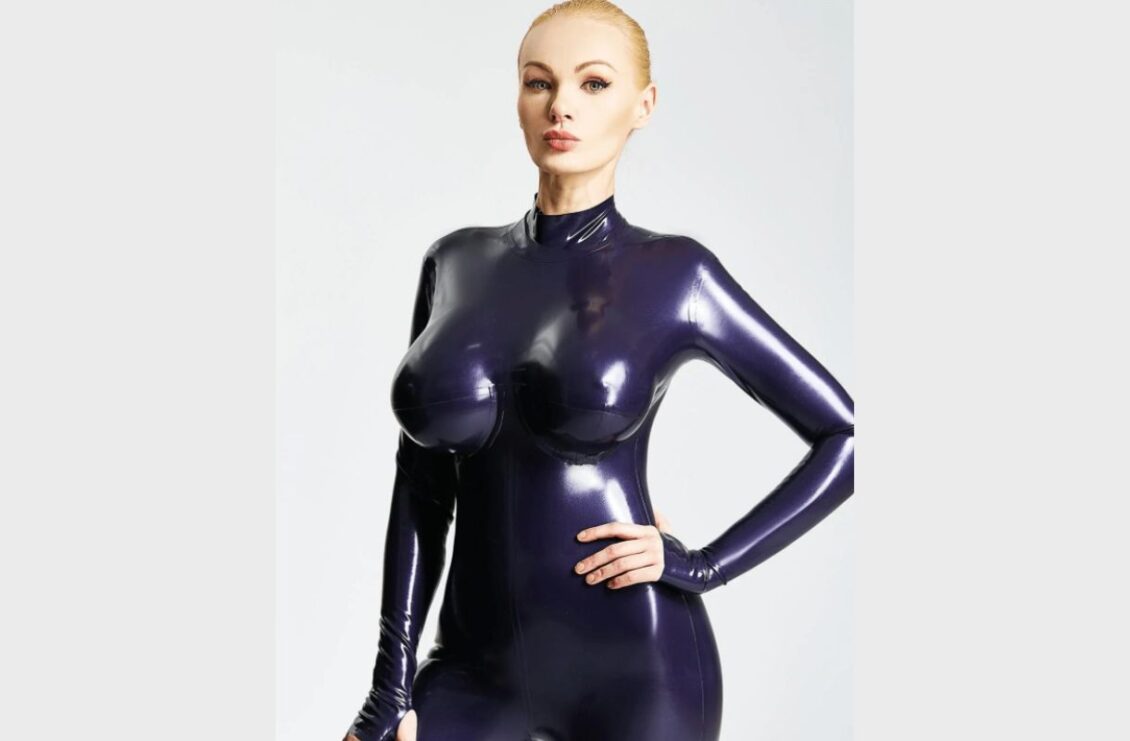
Most customers who ask about chest shaping in a full latex catsuit already know what they don’t want. They’ve tried detachable inserts. They’ve dealt with the shifting, the sagging halfway through a shoot, the asymmetry that sets in after two hours of wear. By the time they contact us, they’re not asking whether it’s possible — they’re asking whether we’ll actually do it properly.
This catsuit is our answer to that question.
The problem with surface-only shaping
A well-cut latex catsuit does a lot of things beautifully. It traces the body, responds to movement, and — when polished — turns ambient light into something architectural. But the chest panel of a standard catsuit is still just latex over air. The fit is clean, but there’s no volume. No weight. Nothing that behaves the way a real chest behaves when you move.
The obvious workaround is external inserts. But anyone who’s worn them knows the tradeoff: they shift. The heavier the insert, the worse the problem. By the end of a session, you’re readjusting constantly, and the visual result — that crisp, rounded silhouette you were going for — has softened into something uneven and unconvincing.
We’ve had this conversation with enough wearers to know it’s not a minor inconvenience. For some, it’s the reason they stopped pursuing that particular look entirely.
What integrated actually means
The chest system in this catsuit is built from the inside out. There are dedicated interior pockets and an embedded harness framework — not stitched on after the fact, but considered from the first pattern cut. The silicone inserts seat into the suit and stay there. Not because they’re wedged in tightly, but because the structure is designed around them.
We offer three weight options: 2000g, 2400g, and 3000g. Each one produces a distinctly different drape. The 2000g sits closer to a natural resting position — present but not dominant. The 3000g creates full, rounded projection with the kind of weight that moves convincingly when the body moves. None of them sag. None of them need to be corrected mid-wear.
After six hours in the 2400g version, the suit hadn’t shifted. The silhouette at the end of the session looked the same as it did at the beginning. That kind of consistency is what the design is for.
Why 0.4mm, and why metallic purple
The latex is 0.4mm — our most-used weight for full catsuits, and deliberately so. It’s thick enough to hold tailored lines without bagging at the knee or wrinkling across the torso, but responsive enough that nothing feels rigid. With a weighted chest system, you want the surrounding latex to move with it, not against it. 0.4mm does that.
Metallic purple at this thickness behaves differently than a standard solid colour. In low, directional light, the torso reads as deep violet — structured, receding. When the body turns, the highlight shifts to a cleaner, brighter purple that traces the curve. It’s not a static finish. The wearer’s movement becomes part of the visual.
We photographed a sample in direct and ambient light specifically to understand how the metallic formulation performs across conditions. The result holds across both — which isn’t true of every metallic latex we’ve worked with.
The secondary details
The gauntlet sleeves extend to full hand coverage, which keeps the full-body line unbroken at the wrist. The foot-ankle loop holds the leg latex taut without adding bulk at the foot — a detail that matters more than it sounds when the suit is being worn for more than an hour. The centre-back zip runs to the waist, leaving the entire front torso clean.
None of these are afterthoughts. A chest-forward suit needs everything else to be resolved, or the shaping reads as a feature bolted onto an otherwise standard catsuit. The gauntlets, the ankle loop, the zip placement — they’re all doing structural work, keeping the eye on the silhouette rather than breaking it.
If you’ve been looking for a silicone breast catsuit that handles chest shaping without the usual compromises, this is the one we’d point you to.
