

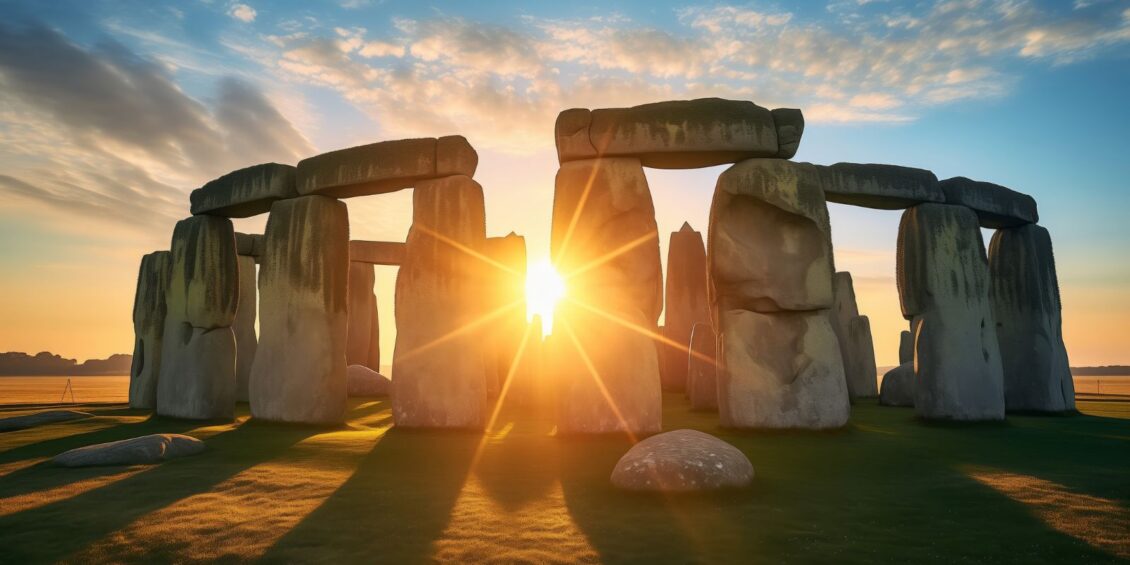
The largest “bluestone” at the heart of Stonehenge came from northern Scotland, not Wales, according to new research.
Published in the journal Nature, the study analysed the age and chemistry of minerals from fragments of the Altar Stone.
The findings show a remarkable similarity between the Old Red Sandstone of the Orcadian Basin in northeast Scotland and the Stonehenge Altar Stone.
Construction at Stonehenge began 5,000 years ago, with changes and additions over the next two millennia.
Although it is unclear when the Altar Stone arrived at Stonehenge, it may have been placed within the world-renowned central horseshoe of stones during the second construction phase at around 2620 – 2480 BC.
For the past hundred years, the iconic six-tonne Altar Stone at the heart of the ancient site was believed to have come from Wales.
The majority of Stonehenge’s world-renowned ‘bluestones’ came from the Preseli Hills area in west Wales and are believed to have been the first stones erected at the Wiltshire site.
The Altar Stone, a sandstone, has traditionally been grouped with these other, smaller, igneous bluestones.
However, the Altar Stone’s origins had remained an open question, until now.
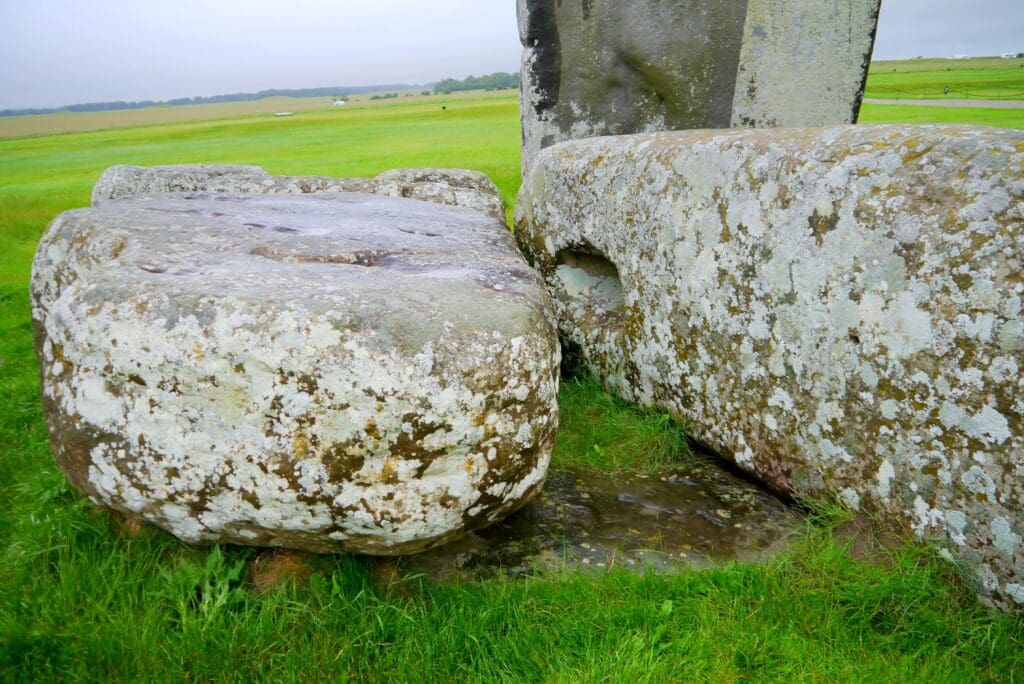
According to the new research involving scientists at Aberystwyth University, UCL, Curtin University and the University of Adelaide, both the chemical composition and the ages of mineral grains in the sandstone indicate it is very likely to have come from northeast Scotland.
The scientists used their analysis of the ages of the mineral grains to create a ‘fingerprint’ of the source of those grains. They matched ages found in rocks of the Orcadian Basin found in the north-east of Scotland, and are completely different from Welsh-sourced stones.
Co-author Professor Richard Bevins from Aberystwyth University said:
“These findings are truly remarkable – they overturn what had been thought for the past century. We have succeeded in working out, if you like, the age and chemical fingerprints of perhaps one of the most famous of stones in the world-renowned ancient monument.
“It’s thrilling to know that our chemical analysis and dating work has finally unlocked this great mystery. We can now say that this iconic rock is Scottish and not Welsh. Although we can say that much, and confidently – the hunt will still very much be on to pin down where exactly in the north-east of Scotland the Altar Stone came from.”
The new discovery implies that one of the most famous stones in the world was moved much further than had been believed – at least 700 km (435 miles).
Anthony Clarke from the Timescales of Mineral Systems Group at Curtin University said:
“Considering the technological constraints of the Neolithic, our findings raise fascinating questions about how such massive stone was able to be transported over the vast distance implied. Given major overland barriers en route from north-east Scotland to Salisbury Plain, marine transport is one feasible option.”
Co-author Dr Robert Ixer of the UCL Institute of Archaeology said: “This is a genuinely shocking result, but if plate tectonics and atomic physics are correct, then the Altar Stone is Scottish. The work prompts two important questions: why and exactly how was the Altar Stone transported from the very north of Scotland, a distance of more than 700 kilometres, to Stonehenge?”
While the research does not provide direct evidence about how the Altar Stone got to its world-famous location in Wiltshire, the revelation that it travelled so far will raise questions about its journey given the limits of human technology during Neolithic times.
Professor Nick Pearce from Aberystwyth University added:
“This stone has travelled an awful long way – at least 700 km – and this is the longest recorded journey for any stone used in a monument at that period. The distance travelled is astonishing for the time. While the purpose of our new, empirical research was not to answer the question of how it got there, there are obvious physical barriers to transporting by land, but a daunting journey if going by sea. There’s no doubt that this Scottish source shows a high level of societal organisation in the British Isles during the period. These findings will have huge ramifications for understanding communities in Neolithic times, their levels of connectivity and their transport systems.
“Hopefully, people will now start to look at the Altar Stone in a slightly different context in terms of how and when it got to Stonehenge, and where it came from. I am sure this will lead to some new thinking about the development of Stonehenge and its links to the rest of Neolithic Britain.”
The new research builds on findings published by Aberystwyth University and UCL researchers last year in the Journal of Archaeological Science: Reports that cast doubt on the Altar Stone’s Welsh origins, and suggested that it should not be classified as a bluestone.
This study was supported by a Leverhulme Trust Emeritus Fellowship, Salisbury Museum and Amgueddfa Cymru – Museum Wales and funded by an Australian Research Council Discovery Project. It was a collaboration between Aberystwyth University, Curtin University, the University of Adelaide, and UCL.
