

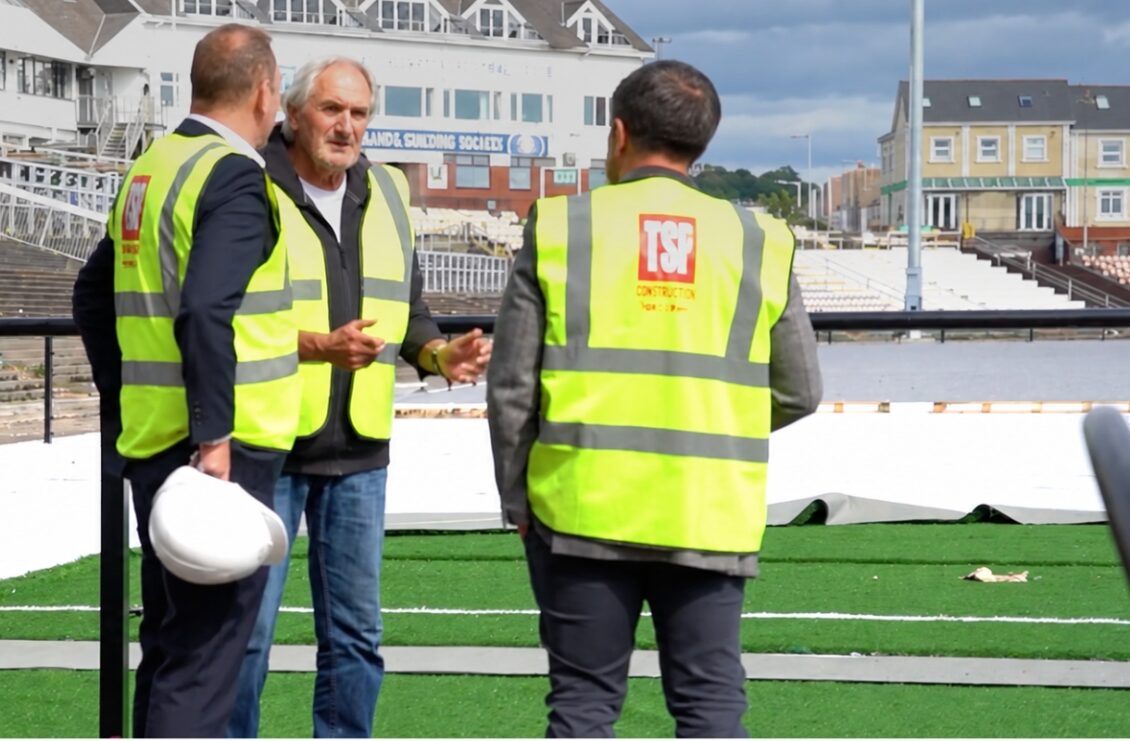
Swansea’s historic St Helen’s Ground is taking shape ahead of its new era as a community stadium and permanent home of the Ospreys.
Work is progressing on the new floodlights, while a new artificial pitch is being laid as part of the £7.6m transformation of the famous sporting venue.
The project aims to create a modern stadium while respecting the heritage of the ground, with significantly improved facilities for players, supporters and the wider Swansea community.
The investment will also secure the long-term future of St Helen’s, with the upgraded venue set to offer extensive community use alongside top-flight rugby.
Swansea Council Leader Rob Stewart visited the site to see progress on the artificial pitch and said the new stadium would benefit the community and help strengthen the local economy.
He said: “It’s fantastic to see the ground taking shape. You can already see the outline of the pitch with floodlights in each corner and the pitch is now being laid.
“The Ospreys are aiming to play their first home game at St Helen’s towards the end of October against the Dragons when fans will be able to experience the new home and a brilliant atmosphere for themselves.
“But it’s not just about the Ospreys. St Helen’s is going to be a vibrant community hub, supporting grassroots sport, schools and colleges, while promoting healthier, more active lifestyles across Swansea.”
The existing clubhouse is being brought into council ownership, providing modern changing facilities, accessible amenities and flexible indoor spaces for sport and wider community use. The facilities will also be available for non-sporting events and functions.
The new 3G pitch has been repositioned so it sits closer to a newly refurbished terrace, with the aim of improving the atmosphere and spectator experience.
Its artificial surface will allow the venue to accommodate significantly more use throughout the year, opening St Helen’s to grassroots rugby, schools, colleges and other community activities alongside the Ospreys’ professional rugby programme.
The existing stand is being relocated to the Mumbles end of the ground, while a new stand with close to 2,000 seats will replace it on the seafront side.
Plans also include a new fan zone and hospitality offer at the Guildhall end, creating a focal point for match days and year-round activities.
Cllr Stewart said: “The new era for St Helen’s starts now. It’ll be home of both the Ospreys and Swansea RFC, ensuring elite rugby continues at a site that has been central to Welsh sport since 1876.
“On this ground, Wales hosted their first home international rugby match and the All Whites were the first northern hemisphere club to beat the All Blacks, the Springboks and the Wallabies at St Helen’s. It’s a proud rugby heritage we’re delighted to see being developed for new generations.”
Roger Blyth, Director at Ospreys Rugby, said: “It is hugely exciting to see the progress being made at St Helen’s as we move closer to making it the permanent home of the Ospreys.
“This is a hugely important project for the club, not only giving us a genuine home for our players and supporters, but also providing a platform for the long-term future and ambitions of the Ospreys. It gives us the opportunity to build a stronger and more sustainable club, while ensuring St Helen’s remains at the heart of rugby and the wider community in Swansea.
“We’re looking forward to seeing the development continue over the coming weeks and, most importantly, welcoming our supporters from across the region through the gates for our first game at St Helen’s.”
As part of the project, the Ospreys are investing £2.6m, securing a 50-year lease and taking full responsibility for match day operations at the venue.
The upgraded St Helen’s will meet the standards required to host United Rugby Championship and European competition, as the venue prepares for its new role at the heart of professional and community rugby in Swansea.
