

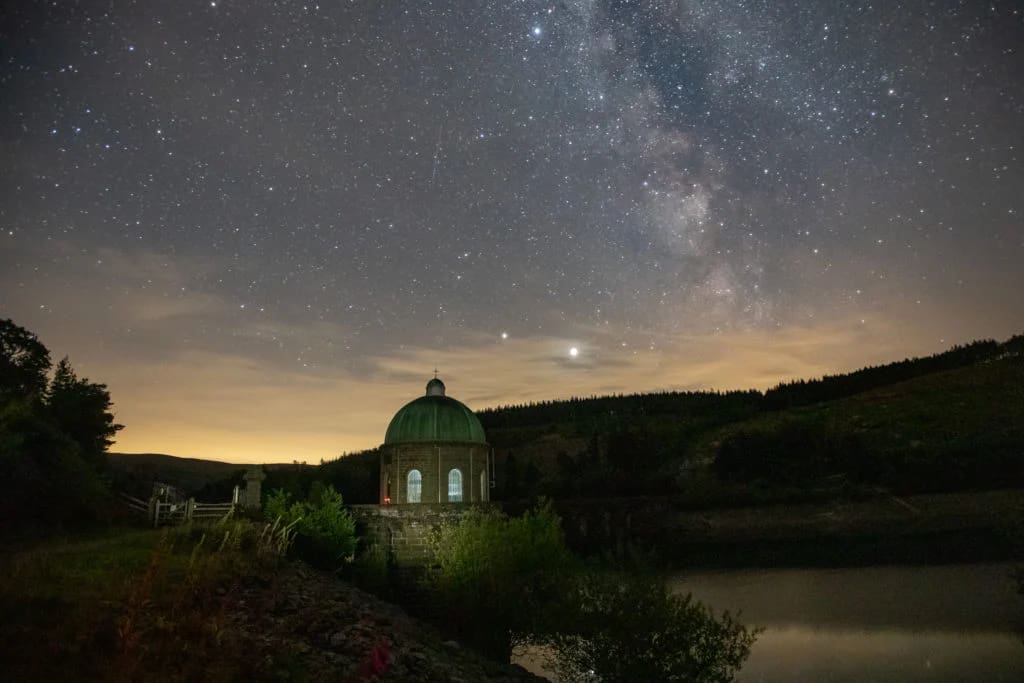
A new ranking has named Elan Valley in Wales among Europe’s best places for a holiday under the stars, beating destinations across Switzerland, Norway and the Netherlands.
Whether you’re someone who regularly checks your horoscope and looks to the stars for guidance, or the type to sling a telescope over your shoulder and trek into open fields in search of obscure constellations, there’s no denying the magic of stargazing.
It’s one of the most scenic and awe-inspiring ways to connect with the night sky – and the latest research shows some of Europe’s best destinations could be closer to home than you think.
Avanti Travel Insurance analysed 30 leading stargazing destinations across Europe to identify the best places for astronomy enthusiasts and curious travellers. The ranking is based on light pollution, annual sunshine hours, altitude and visitor infrastructure.
UK stargazing triumph over European rivals
The research proves that British travellers don’t always need to leave the country to experience spectacular night skies, with two UK places both securing spots in the European top 10.
-
Elan Valley, Wales – The Welsh destination secured sixth place, showing that travellers can experience spectacular night skies without leaving the UK.
- Tomintoul & Glenlivet Dark Sky Discovery Site, Scotland – The Scottish destination ranked five, giving UK travellers another option for swapping city lights for starlight.
Avanti’s travel expert Sarah Rodrigues says: “Astrotourism is becoming more appealing as travellers look for experiences that encourage them to slow down and connect with a destination in a different way. You don’t necessarily need to travel to a remote corner of the world to do that – some of the best night skies are much closer to home. For anyone planning a trip, it’s also worth checking the moon phase and weather forecast before travelling, as darker, clearer nights can make a huge difference to what you’re able to see.
Whether you’re heading to the Canary Islands to stargaze from an observatory or travelling to a dark sky park in rural Wales, astrotourism can take you to some beautiful but remote locations.”
Europe’s best places to look up
Topping the list is Reserva Starlight La Palma in Spain, which scored 9.1 out of 10.
Recognised as the world’s first Starlight Reserve, La Palma was also one of the first destinations to introduce a “Sky Law”, designed to protect the quality of the night sky for astrophysical observation. With exceptionally clear skies and the Roque de los Muchachos Observatory offering a renowned vantage point for stargazing, La Palma claimed the top spot.
Rounding out the top three are Réserve Internationale de Ciel Étoilé du Pic du Midi and the Alpes Azur Mercantour Dark Sky Reserve, both in France.
Perfect for a stargazing staycation
The appearance of Elan Valley among Europe’s top stargazing destinations shows that some of the continent’s most impressive night skies can be found much closer to home.
Stargazing can also offer a different way to experience the destinations themselves.
A day might be spent hiking through mountain landscapes, exploring villages or enjoying the local food, before nightfall shifts the focus upwards.
For travellers looking to swap city lights for starlight, the ranking offers plenty of inspiration – whether that means heading to the Canary Islands or staying closer to home in rural Wales.
Unlike many of Europe’s celebrated sights, there is no need to queue for the best view. There is no closing time, no entrance ticket and no itinerary to follow. The attraction simply appears once the sun has gone down.
Zoltan Trenovszki, an astronomy enthusiast and managing director at 365 Astronomy, comments:
“A location can be beautiful, but if there is significant artificial light, you will see much less of the night sky. So, choosing a recognised dark-sky location can make a huge difference to what you’re able to observe.”
Zoltan’s top tips for stargazing
- “Visit a place with little artificial light, like a park or a reserve.
- Let your eyes adjust to the darkness. It can actually take 20-30 minutes for your night vision to become properly established. Try not to look at your phone screen or a torch during this time.
- If you need to use a light, it’s better to try a dim red light, as this is much less disruptive to your dark adaptation.
- Check the weather and the moon phase before heading out. Clear skies are essential, but a bright moon can make stars look a lot fainter.
- You don’t need expensive equipment to get started. Your eyes can reveal an incredible amount under genuinely dark skies, including constellations, bright planets, the Milky Way, and shooting stars.
- Binoculars are also a good first step, because they’re easy to use, and can allow you to see that extra fine detail.
- Try using averted vision when looking for faint stars – instead of staring directly at them, look slightly to one side.
- The more light-sensitive parts of your retina sit away from the centre of your vision, so this can make faint stars suddenly appear more clearly.
