

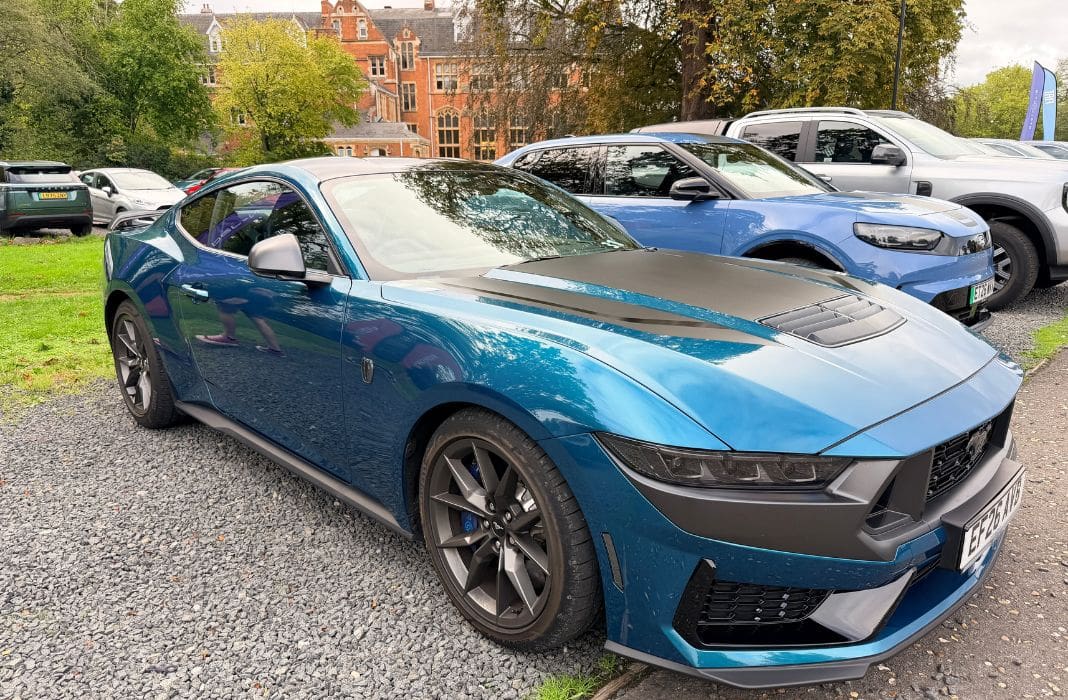
The motoring world might be rapidly moving towards electrification, but Ford is proving there is still plenty of life left in one of the most traditional performance car formulas.
A 5.0-litre V8 engine, rear-wheel drive and, crucially, a six-speed manual gearbox are at the heart of the Ford Mustang Dark Horse, the more performance-focused version of the latest generation Mustang.
Wales 247 got behind the wheel at the recent SMMT Drive Live event at Stanbrook Abbey near Worcester for a first taste of a car that feels increasingly unusual in today’s automotive landscape.
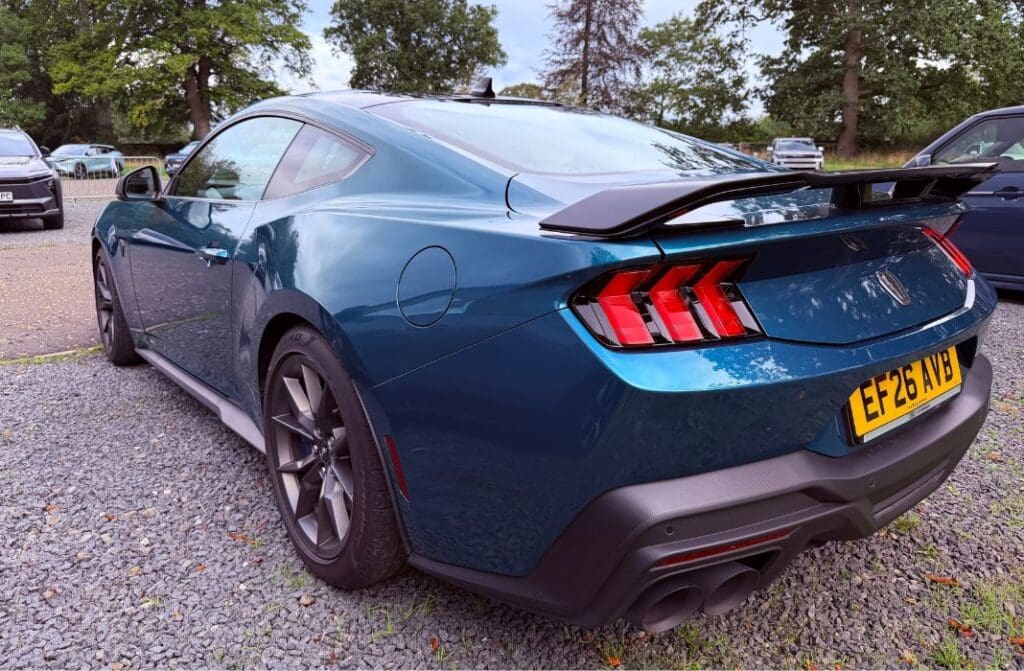
With only a short amount of time behind the wheel, this isn’t a full road test, but it was enough to discover that the Dark Horse offers considerably more than straight-line American muscle.
A Mustang turned up a notch
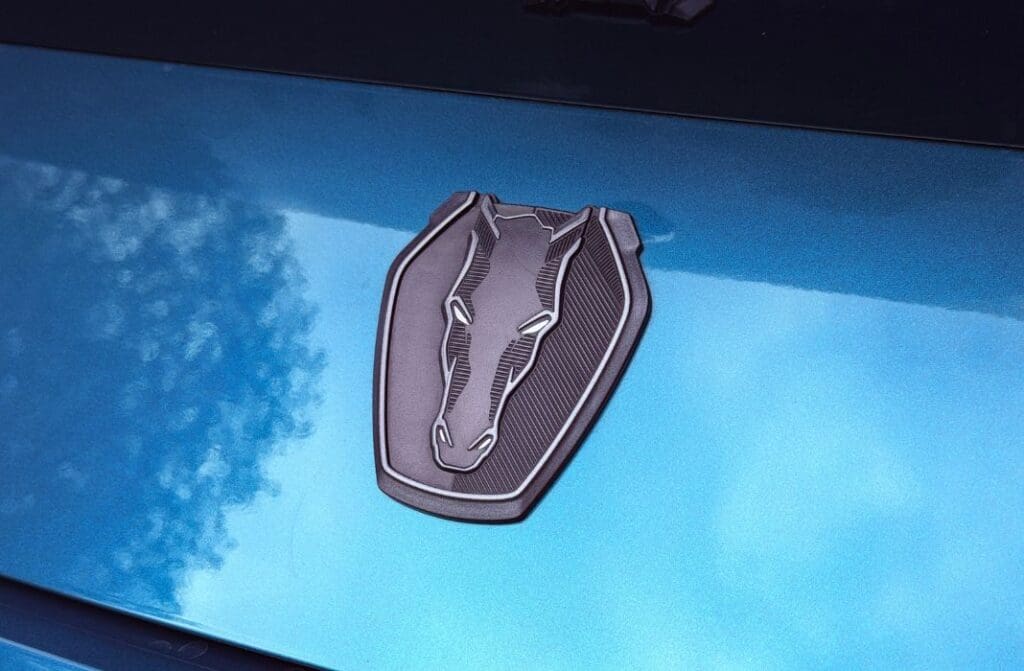
The Dark Horse sits above the Mustang GT and is designed as a more focused interpretation of Ford’s famous muscle car.
Its 5.0-litre Coyote V8 produces around 500hp, accompanied by approximately 418lb-ft of torque.
But the Dark Horse isn’t simply a Mustang GT with some extra power.
Ford has made significant changes beneath the surface, including specifically tuned MagneRide adaptive suspension and a Torsen limited-slip differential. Manual versions also get a unique six-speed Tremec gearbox.
The result is a Mustang designed to deliver a more focused driving experience while remaining usable on the road.
From the outside, the Dark Horse retains the unmistakable proportions of the modern Mustang, with its long bonnet, muscular stance and familiar fastback profile.
It’s inside where the transformation becomes much more obvious.
A much more digital Mustang
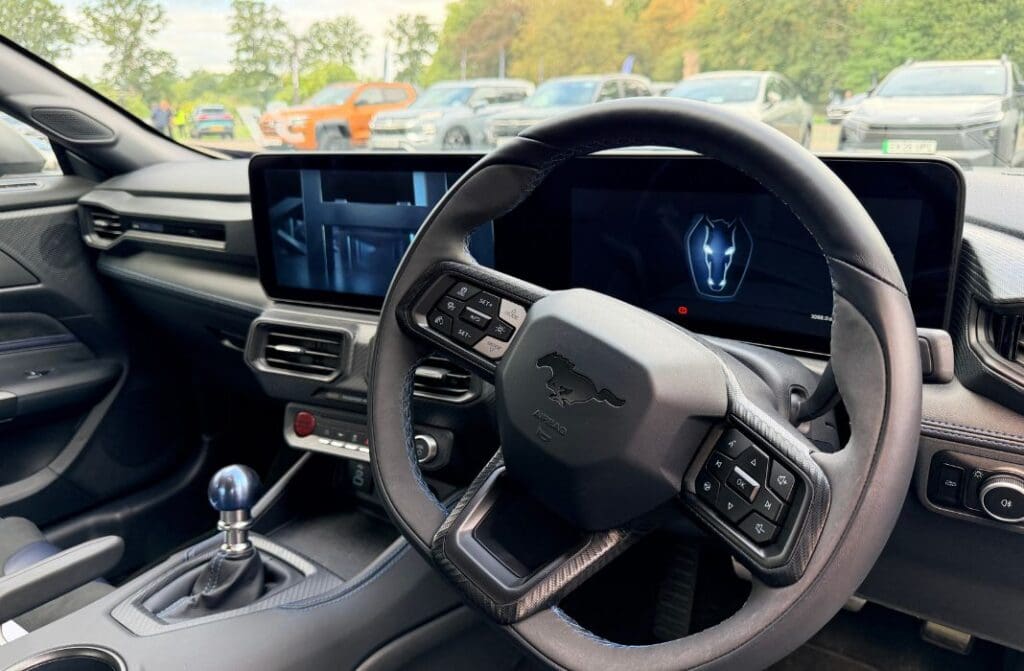
The cabin has taken a considerable step into the digital age, with large screens dominating the dashboard and giving drivers access to numerous displays and settings.
It feels very different from Mustangs of the past.
There wasn’t enough time during our first drive to delve deeply into the various menus and customisation options, but the technology certainly makes this feel like a thoroughly modern performance car.
There are still some welcome traditional touches, though.
Press the start button and the 5.0-litre V8 immediately makes its presence known.
Then there’s the manual gearbox.
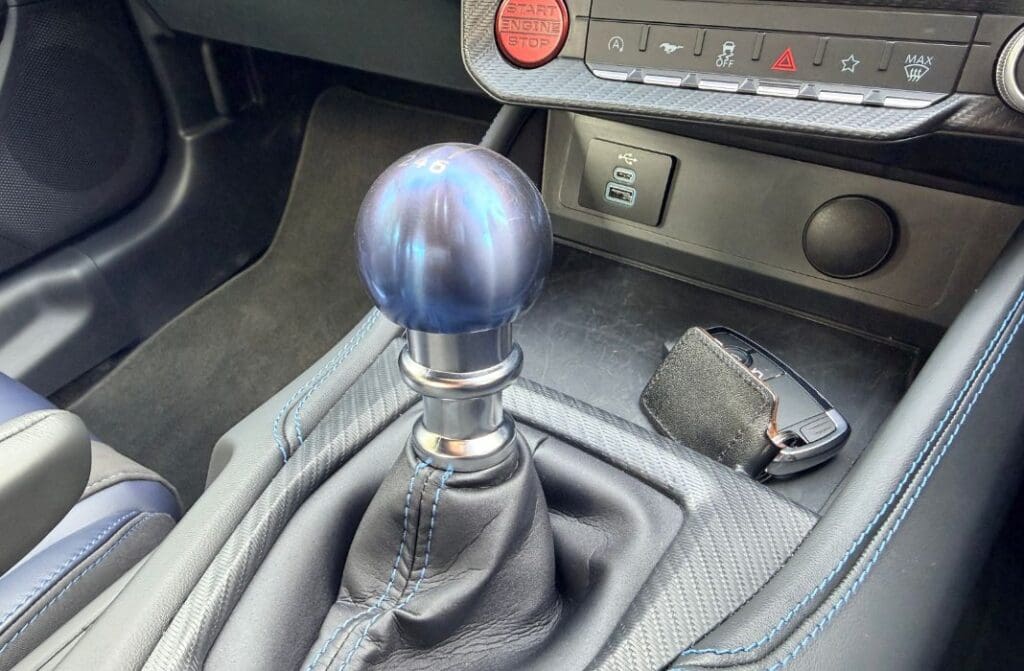
Ford fits the manual Dark Horse with a unique six-speed Tremec transmission as standard, complete with a titanium gear knob.
The gearbox proved to be one of the highlights of the drive.
Its relatively short shifts feel precise and confident, while the clutch and gearbox combination make the Dark Horse surprisingly easy to drive.
Even after spending much more time recently driving automatic and electric cars, it only took a few minutes to feel comfortable with the manual Mustang.
And you’ll want to use that gearbox.
A V8 worth changing gear for
Downshifting is almost addictive, largely because of the soundtrack accompanying every change.
The Coyote V8 can rev to around 7,500rpm and encourages the driver to make the most of the engine rather than simply relying on its power and torque.
Even getting caught in traffic didn’t feel like much of a chore.
There’s something refreshing about having to physically work with a performance car again, particularly after driving several electric vehicles where enormous acceleration is available almost instantly.
That’s not a criticism of EVs. Their performance can be extraordinary. But the Mustang provides a very different experience.
There’s the noise, the vibration, the changing gears and the process of building the revs before shifting again.
It makes the driver part of the experience.
The digital dashboard even provides a prominent indication of the selected gear, which is more useful than you might expect when you’re getting accustomed to the car.
Can a Mustang handle?
American muscle cars have historically been associated more with straight-line speed than attacking a British B-road.
The Dark Horse challenges that stereotype.
Our route included country lanes around Worcester, giving us an opportunity to experience the car on the type of road where a large V8-powered Mustang might traditionally have felt slightly out of place.
Instead, the Dark Horse felt composed.
Its specifically tuned MagneRide adaptive suspension continuously works to control the car, while Ford has also equipped the Dark Horse with additional performance hardware designed to cope with more demanding driving.
The suspension dealt particularly well with uneven road surfaces, smoothing out bumps without taking away the feeling of connection with the road.
Despite its size and power, the Mustang didn’t feel intimidating either.
The steering, gearbox and visibility quickly make the car feel approachable, while the seats provide a good balance between support and comfort.
Easier to live with than expected
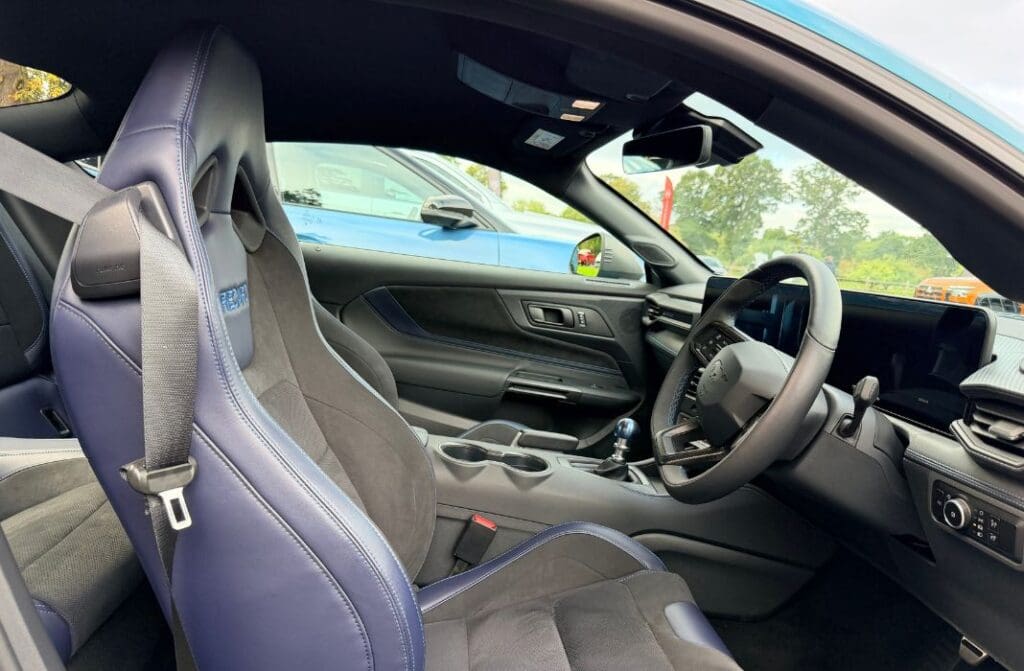
Visibility is another pleasant surprise.
Despite the Mustang’s long bonnet, forward visibility is good, while visibility around the rest of the car compared favourably with some of the electric cars driven at the same event.
One slight criticism concerns the passenger-side door mirror. Although this was a right-hand-drive car, some elements still give the impression that the Mustang was originally designed around a left-hand-drive layout.
A little more adjustment from the left mirror would have been welcome, although it took only a few minutes to become accustomed to it.
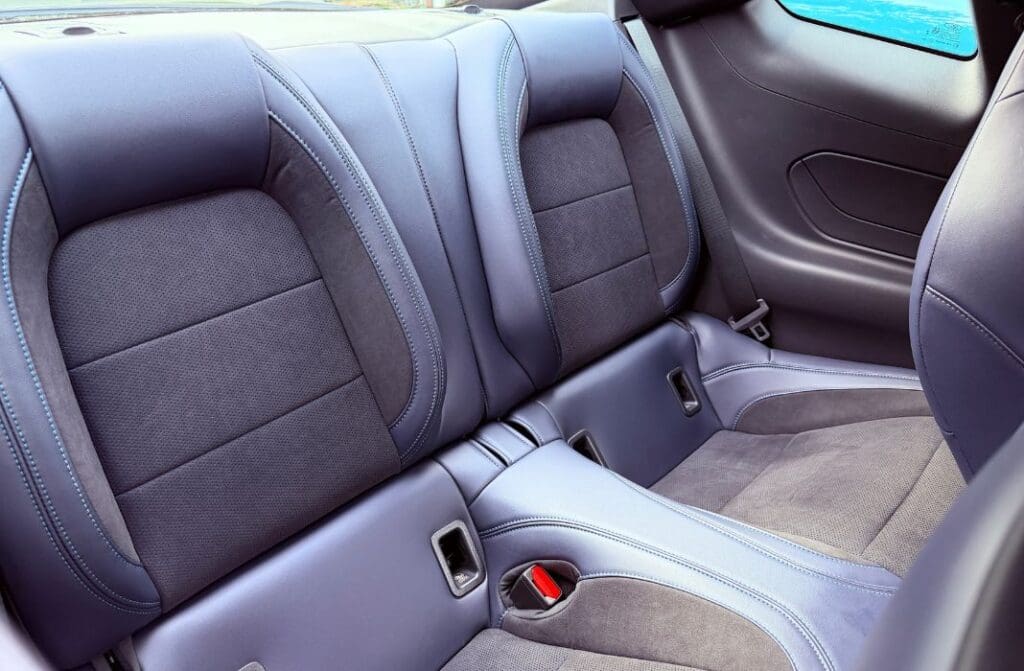
There’s also more practicality than you might expect from a performance car.
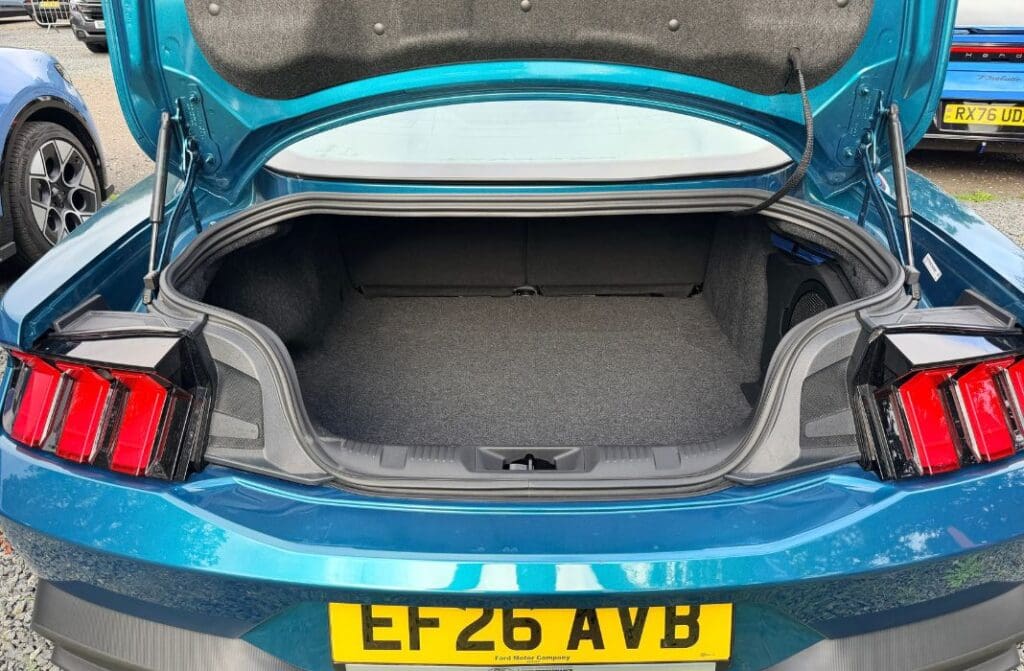
The Mustang has rear seats and a usable boot, even if neither is particularly generous. It means there’s at least the potential to use the Dark Horse for more than weekend drives and track days.
First impressions
The Ford Mustang Dark Horse arrives at an interesting moment.
Performance cars are changing quickly and electrification is delivering levels of acceleration that would have seemed extraordinary only a decade ago.
Against that backdrop, a naturally aspirated 5.0-litre V8 connected to a six-speed manual gearbox feels almost rebellious.
Yet the Dark Horse isn’t simply relying on nostalgia.
Its adaptive suspension, modern chassis, digital interior and performance upgrades bring the Mustang formula firmly into the present day. Ford itself describes the model as a Mustang with the performance “dial turned up”.
After a relatively short first drive, the strongest impression is just how much character it offers.
It’s fast, comfortable, surprisingly composed on a country road and easy to drive. But above everything else, it feels involving.
For drivers brought up dreaming about V8-powered Mustangs, that matters.
Cars like this are becoming increasingly rare, and nobody knows exactly how long the combination of a large naturally aspirated engine and manual gearbox will remain available.
The Mustang Dark Horse therefore feels like something worth experiencing while we still can.
Our first drive took place during SMMT Drive Live at Stanbrook Abbey, Worcester, on 23 September 2026.
