

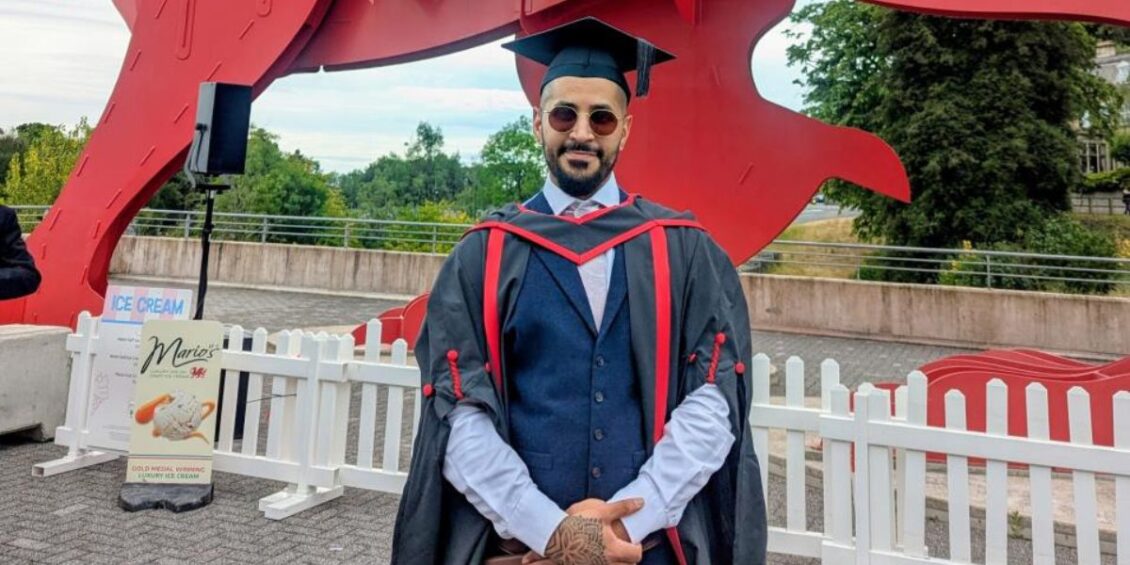
University of South Wales (USW) graduate Mohammed Hassanin has overcome homelessness, addiction, and deep personal challenges to earn a first-class honours degree in Counselling and Therapeutic Practice.
When Mohammed Hassanin walks across the stage this week to collect his degree, it won’t just mark the end of his studies – it will represent the culmination of a remarkable journey.
A former rough sleeper who struggled with addiction, Mohammed, is now a qualified counsellor with big ambitions to help others to navigate their own emotional challenges.
“I’ve just qualified with first-class honours,” he said. “Honestly, it still hasn’t quite sunk in.”
Mohammed grew up in London but has lived in Pontypool, South Wales, for the last five years. He moved there in early 2020, shortly after leaving hospital with suspected pneumonia, likely COVID-19, though tests weren’t available at the time.
At that point, he had been homeless for five years, using drugs daily and moving from place to place across London.
“I had no fixed base,” he explains. “I’d lost my job, my connection with my family was broken, and the addiction was louder than everything else. It took over every part of my life.”
Mohammed had intended only to rest briefly at his family’s farm in Pontypool. But when the first COVID lockdown hit, he found himself stuck, and for the first time in years, sober.
“That forced a pause, which it saved my life,” he said.
Slowly, he began to engage with recovery, finding a local Narcotics Anonymous group, attending sewing classes, and re-connecting with his family.
He also began counselling sessions, and soon found himself drawn to the profession.
“I asked my counsellor how they got into it their career and they mentioned USW,” he recalls. “A year later, I applied.”
Mohammed began his BA (Hons) in Counselling and Therapeutic Practice at USW with no expectations, just a willingness to learn and a hope that he could help others.
He said: “The course was challenging in ways I didn’t expect. I knew it would be emotionally intense, but the depth of reflection it required was more than I imagined.”
He also struggled with the academic side at first.
“Every time I opened a new assignment brief, I felt overwhelmed. The academic language made me feel stupid and like I couldn’t do it. But the support I got from tutors and peers helped me keep going.”
He credits the course’s personal development group, where students reflect together on their emotional experiences, with helping him build resilience and deepen his self-awareness.
“The emotional discomfort was hard,” he says. “But it was also what made the learning feel real. It was painful at times but incredibly rewarding.”
Now fully qualified, Mohammed is continuing to see clients through his work placement while exploring part-time work and setting up his own practice. His vision for the future involves counselling, recovery coaching, and men’s mental health retreats.
“I feel a strong calling to work with men, “he said. “Especially around masculinity, shame, and emotional wellbeing,” he says. “I think men need spaces to talk about what it means to be a man, to be strong, to feel, and to be vulnerable.”
As a Muslim man in recovery, Mohammed also feels passionate about supporting young Muslim men who may be struggling with identity, addiction, or mental health.
“I know how shame can silence people,” he explained. “It nearly silenced me. Now I want to use what I’ve been through to help others find their voice.”
With almost five years of sobriety under his belt and a degree to his name, Mohammed says he still takes life one step at a time, but his outlook is transformed.
“Fear and low self-worth have prevented me from committing to anything before. I’m no longer resigned to a life of chaos. I’ve found purpose and I’ve found community. Now I get to help others find that too.”
