

This story is also available in Welsh – click here to read it.
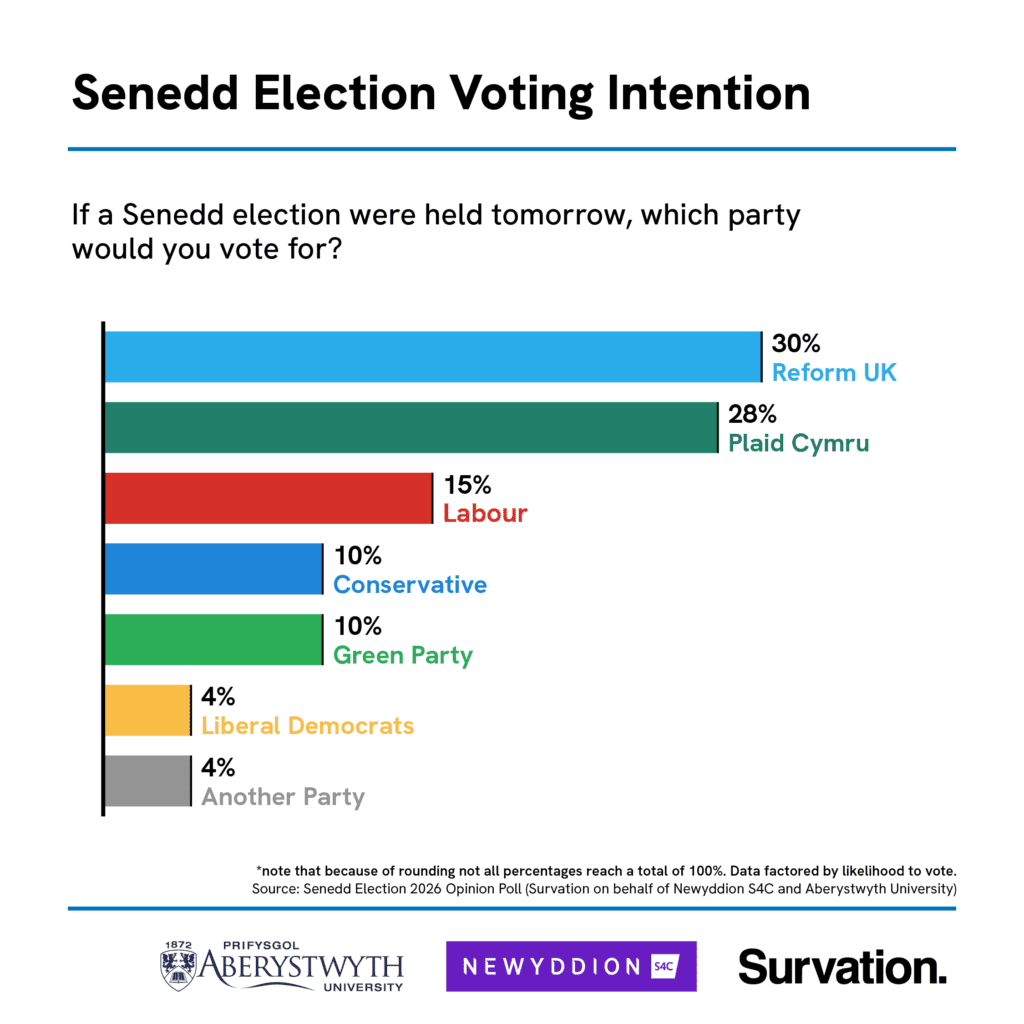
A new poll, conducted by Survation on behalf of Aberystwyth University and Newyddion S4C, places Reform UK slightly ahead of Plaid Cymru in voting intention ahead of the Senedd election.
The results suggest a tightly contested race, with Reform UK on 30% and Plaid Cymru on 28%. Labour follows on 15%, while both the Conservatives and the Green Party are on 10%, Liberal Democrats on 4%, and 4% selecting another party.

Dr Anwen Elias from Aberystwyth University, who led the analysis of the opinion poll, said:
“These findings point to a highly competitive political landscape ahead of the Senedd election, with two parties currently leading in voting intention. While Reform UK are found to hold a slight lead over Plaid Cymru, it is clearly incredibly close between the two parties. On the basis of such close polling results, projecting which party will win the most seats in the Senedd is incredibly difficult. The sixth seat in each constituency is likely to be decided by very small numbers of votes. It is very finely balanced.
“It is also striking that this poll demonstrates how support for the two parties that gained the most seats in the last Senedd elections, Labour and the Conservatives, has fallen so far behind the front-runners. If these results are replicated on 7 May, they will constitute a historic change in our politics.”
Around two-thirds of voters identify the cost of living at 67% and NHS and healthcare at 64% as the most important factors influencing their vote. Immigration at 39% and the economy more generally at 31% also rank highly, while housing, climate change, crime and education are selected by smaller numbers of respondents.
The survey also finds that most people in Wales are interested in politics in general at 60%, and that just over half have been following the election campaign at least to some extent.
Engagement varies significantly by age, with older people more likely to be interested in and engaged with politics than younger people. Among those aged 65 and over, more than two-thirds say they have paid a lot or some attention to the election campaign, compared with less than half of 16 to 24-year-olds.
20% of respondents say Plaid Cymru is running the best election campaign, closely followed by Reform UK on 18%, while 39% say they do not know which party is running the best campaign.
When asked which party best stands up for Wales’ interests, Plaid Cymru leads on 34%, followed by Reform UK on 16%. However, more than a quarter of respondents say that none of the parties best represents Wales’ interests or that they do not know.
Dr Elias added:
“The data also show that levels of engagement with the campaign vary considerably, particularly by age, with many younger voters less closely engaged than older groups.
“The results also highlight the importance of everyday concerns in shaping voter priorities, especially the cost of living and pressures on the NHS. At the same time, there is a notable gap between voting intention and perceptions of which party best represents Wales’ interests, suggesting that voters draw on a range of considerations when voting.”
The survey was based on a representative sample of 1,065 adults aged 16 and over in Wales, surveyed between 17 and 23 April 2026 via an online panel. Results were weighted to reflect the population profile of Wales. Voting intention figures are weighted by respondents’ likelihood of voting.
The findings will be discussed on 30 April from 17:15 to 18:30 in the Main Hall of the Department of International Politics on Penglais Campus. The event will explore changes in how people vote and the latest polling data, including findings from the Welsh Election Study, a research project examining political attitudes and behaviour in Wales. It will also reflect on what the findings mean for Wales after 7 May.
