

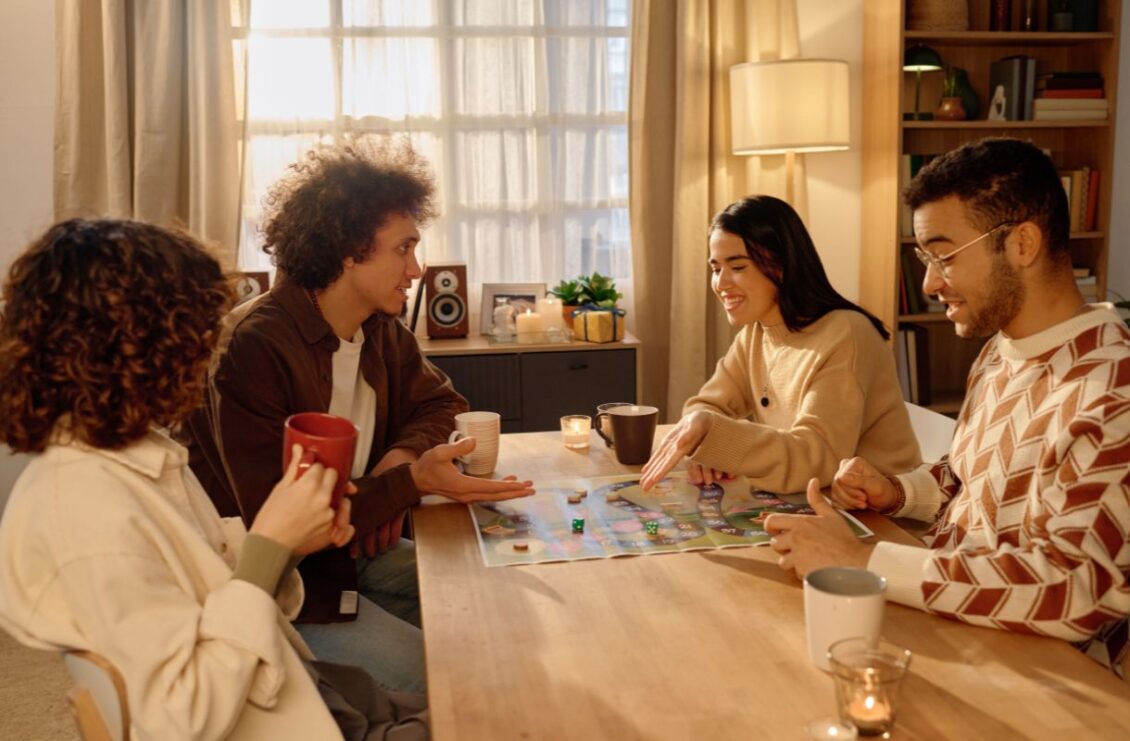
Learning Welsh can feel like a warm conversation among friends when you bring games into the mix. Games make language learning vivid and playful, helping you internalise new words through repetition, action and social interaction. No matter if you are a parent, teacher or adult learner, games offer low-pressure opportunities for speaking, listening and remembering. In Wales, education policy under Cymraeg 2050 (the Welsh Government’s strategy to reach a million Welsh speakers) emphasises creating fun, everyday chances to use Cymraeg in social and community settings.
Games do exactly that: they help you practise real, conversational Welsh while feeling like you’re just having fun. In both nursery settings and adult-learner classes, short, dynamic games reduce cognitive load so your mind can focus less on grammar and more on meaning and pronunciation. Over time, this kind of playful exposure helps build confidence in speaking Welsh in your daily life, and, critically, encourages repeated use outside of formal lessons.
That matters: according to the latest Annual Population Survey (year ending June 2025), approximately 27.2% of people aged three years and over in Wales can speak Welsh, which works out to roughly 836,800 speakers.
Bingo and call-and-response games
One of the most time-honoured tools in Welsh-language teaching is bingo, adapted to encourage vocabulary building for both children and adults. You might have played a bingo variant in class or during a community session: each board contains Welsh words or images, with the caller naming the English equivalent or showing pictures, prompting learners to listen and match. This simple structure makes bingo highly effective, prompting you to react and recognise words quickly.
Interestingly, familiar interactive formats from leisure-gaming culture carry over: even in commercial settings, UK bingo sites use similar call-and-response mechanics, which makes the structure feel intuitive to learners. In a teaching context, bingo can be themed (colours, food, verbs, emotions), allowing you to adapt cards as your vocabulary grows. Teachers often encourage learners to make their own call-lists so that you practise spelling and comprehension actively.
Ultimately, this approach works across age groups, whether in primary classes or adult-learning programmes, because it scales easily and it feels accessible.
Card games, matching and digital apps
Beyond bingo, card-based games support visual and auditory learning of Welsh vocabulary; for example, matching-pairs games use cards with a picture on one side and a Welsh word on the other, helping you link meaning and sound. Similarly, ‘snap’-style games encourage rapid recognition, which are particularly popular with young learners learning themes like animals, food or weather.
On the digital front, there are many free and paid apps tailored to Welsh learners. Among them are interactive reading schemes, such as apps from Ebbw Fawr that include Campau Cosmig, a compilation of over sixty mini-games designed to reinforce vocabulary and Codi Hwyl, which offers themed matching games aboard a pirate ship.
There is also Seren Sillafu, which combines spelling challenges and listening exercises. For very young children, the S4C-backed Cyw app offers songs, counting games and alphabet fun.
Essentially, these digital games offer gamified, spaced repetition practice you can return to at home or on the go, making the learning of Welsh flexible and personalised.
Role-play, board games and social play
Role-play games bring Welsh alive by immersing you in real-life scenarios, such as a café, a shop or a travel situation. You might act out a customer ordering food in Welsh or negotiate directions at a mock market stall, with these interactions encouraging you to use practical phrases, ask questions and respond naturally, helping fluency emerge from rehearsal.
Board games, too, are easily adapted: classic favourites like Scrabble can be played with Welsh-letter tiles or Monopoly reimagined with Welsh property names, prompting conversation about money, purchasing and decision making in Welsh.
Meanwhile, community and youth organisations like Urdd Gobaith Cymru support such playful environments, encouraging members to speak Welsh in cooperative games at clubs and camps. Family-based sessions, such as intergenerational playgroups, mix toddlers, older children and parents to practise Welsh in comfortable, social contexts.
The spontaneous, unscripted exchanges that arise during play promote more natural speech, reinforce vocabulary and help all participants feel part of a Welsh-speaking community.
Integrating games into learning
If you want to bring games into your Welsh-learning routine, start with clear objectives: pick a theme or vocabulary set and choose a game that targets exactly that. Keep rounds short and varied: frequent, rapid feedback keeps motivation high and helps you process and repeat new words. Alternate competitive games (like bingo or snap) with cooperative ones (role-play or board games), so everyone in the group feels comfortable contributing.
Pairing more experienced Welsh speakers with beginners can create mentoring dynamics where learners support each other. You can use simple assessment tools, such as checklists or short exit tasks, to gauge how many new words you can use after a session.
At a higher level, learners and teachers can leverage national strategies: the Welsh Government’s Cymraeg 2050 action plan emphasises enhancing digital Welsh-language technology and boosting everyday use of the language, meaning that playful, tech-driven learning aligns directly with long-term goals. Initiatives such as Camau, a funded programme training early-years practitioners in practical Welsh through songs, games and routines, demonstrate how structured game-based learning is already embedded in policy.
For adult learners, intensive courses such as Wlpan continue to thrive alongside digital tools, with tutors often incorporating matching cards or role-play to reinforce core patterns.
Ultimately, game-based learning helps you internalise Welsh in ways that feel natural, social and sustainable, which is exactly the kind of immersive experience that supports both steady progress and confidence to use the language beyond the classroom.
