

While Welsh businesses recorded a sharper fall in output in May, the latest Cymru Growth Tracker from NatWest highlights continued improvement in demand trends, with the decline in new orders easing further.
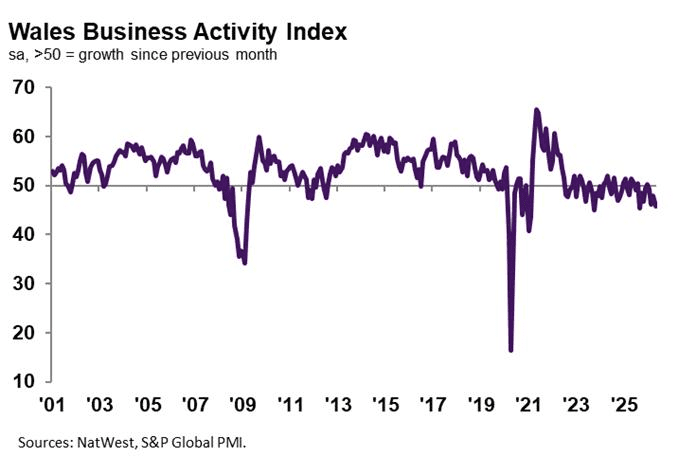
At 45.8 in May, the headline Wales Business Activity Index – a seasonally adjusted index that measures the month-on-month change in the combined output of the area’s manufacturing and service sectors – was down from 47.9 in April, and indicated a strong drop in output levels at Welsh companies. The rate of contraction was the quickest since September 2025, as firms noted that higher costs and growing uncertainty weighed on demand conditions.
Although new orders fell for the fourth month running in May, the pace of decline was only slight and the slowest in this period. Nonetheless, business confidence ticked down and employment fell at the steepest rate since September 2020.
With regards to prices, input costs and output charges rose at faster paces in May, with the former increasing at the sharpest rate since November 2022.
Jessica Shipman, Chair, NatWest Cymru Board, said:
“May data indicated a softer decline in new orders at Welsh firms, however, some of the uplift in the seasonally adjusted New Business Index stemmed from a temporary bout of stockpiling at customers amid higher prices and supply challenges. In fact, activity levels dropped at a sharper pace and employment contracted at a rate not seen since September 2020. Although still confident of output growth in the coming 12 months, spare capacity and greater uncertainty led firms to lower their expectations for the year-ahead outlook.
“Underpinning business and customer decisions in May were heightened inflationary pressures. Input prices and output charges rose again, and at steeper rates, as the conflict in the Middle East pushed up material, fuel and energy costs. Although companies tried to minimise hikes in selling prices, protecting margins is likely fall in priority in the coming months as customer uncertainty and efforts to boost new sales become more crucial to the private sector’s health.”
Performance in relation to UK
Welsh businesses registered another monthly contraction in output during May, with the pace of decline accelerating. In fact, the pace of decrease was the third-fastest of the 12 monitored UK areas, slower than only the East Midlands and Northern Ireland.
Welsh companies recorded a fourth consecutive monthly fall in new sales midway through the second quarter. The pace of decline cooled, however, and was the slowest in this sequence of contraction. The rate of decline was broadly in line with the UK average, however.
Average cost burdens at Welsh companies increased at a substantial pace midway through the second quarter. The rate of cost inflation accelerated to the sharpest since November 2022 and was quicker than the UK average.
In line with a faster rise in input costs, Welsh firms increased their selling prices at a steeper pace in May. The rate of charge inflation was the most marked for over a year and historically elevated, but broadly in line with the UK average.
Welsh private sector firms registered a further fall in staffing levels midway through the second quarter. The rate of job shedding was the sharpest in almost six years and the most marked of the 12 monitored UK areas.
Meanwhile, backlogs of work at Welsh firms continued to contract in May. Although the rate of decline eased from April, it was solid nonetheless. Weak demand conditions reportedly enabled companies to process their outstanding business in a timely manner. The pace of depletion was quicker than the UK trend.
Finally, Welsh businesses remained confident of a rise in output over the coming year, but the level of optimism dipped from that seen in April. The degree of positive sentiment was below the UK and series averages.
