

The renowned bluestone boulders of Stonehenge were transported from Pembrokeshire to Salisbury Plain by humans and not glaciers as previously claimed, according to new scientific research.
A team of experts led by Aberystwyth University – in collaboration with scientists from University College London, the University of South Wales and the University of Exeter – has revisited arguments around whether the large stones were moved more than 200km from west Wales to Wiltshire by ice or people.
They focused their study on a distinctive piece of rock known as the ‘Newall boulder’, which was excavated at Stonehenge in 1924 and which has been central to the debate in recent decades.
Some studies have described the Newall boulder as a glacial erratic, supporting the theory that ice was responsible for transporting the rocks that built the famous stone circle on Salisbury Plain.
However members of the Aberystwyth-led team have carried out a detailed examination of the boulder – using X-ray, geochemical and microscopic analysis as well as surface textural analysis – and say “there is no evidence to support the interpretation that it is a glacial erratic”.
The study also concludes that the Newall boulder is a piece of rhyolite debitage originally sourced from Craig Rhos-y-Felin in north Pembrokeshire and transported to Stonehenge by Neolithic people, possibly being the broken top of Stone 32d, now a buried stump.
Their findings, published in the Journal of Archaeological Science: Reports, are described as the most complete summary to date of the published scientific data relating to the Newall boulder.
Lead author Professor Richard Bevins from the Department of Geography and Earth Sciences at Aberystwyth University said:
“We have carried out detailed examinations of Stonehenge’s Newall boulder and compared it with hundreds of rock samples from Pembrokeshire. Our findings provide convincing evidence that the boulder was detached from a pillar of rhyolite which originated from Craig Rhos-y-Felin, with samples showing identical petrological and mineralogical features not found elsewhere in Pembrokeshire despite extensive examination”.
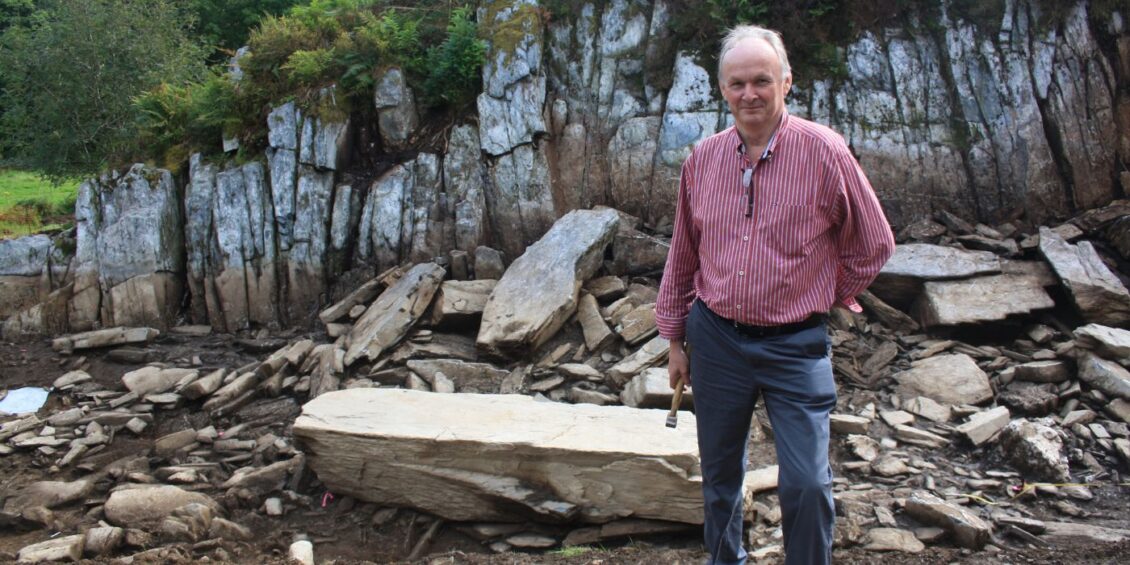
“In collaboration with archaeological colleagues strong evidence of extensive Neolithic stone extraction at Craig Rhos-y-Felin was found, which further supports our argument in favour of human transport of the rocks from Pembrokeshire to Wiltshire. It would have been an incredible feat but, as Stonehenge itself shows, it would have been possible and there is plenty of evidence of haulage technology for moving heavy boulders that would have been available to Neolithic people at that time”.
“Additionally, bluestone has not been found anywhere else on Salisbury Plain with the exception of the immediate environs of Stonehenge itself. Had they been moved there by glaciers, there would be a much more dispersed distribution of similar stones across the region”.
In conclusion, the study authors say “we reiterate our previous interpretation that the Newall boulder is not a glacial erratic, that there is no evidence of glaciation on the Salisbury Plain, and that the bluestones were transported to Stonehenge by humans and not by ice.”
The full list of authors involved in the study includes: Richard E. Bevins, Nick J.G. Pearce and Ian Saunders (Aberystwyth University); Rob A. Ixer and Mike Parker Pearson (University College of London); James Scourse (University of Exeter); Tim Daw, Mike Pitts and David Field (independent researchers); Duncan Pirrie (University of South Wales) and Matthew Power (Vidence inc.).
Professor Bevins and Professor Nick Pearce from Aberystwyth University were also involved in a major study published in 2024 which showed the Altar Stone at the heart of Stonehenge was a sandstone transported from north-east Scotland and was not one of the bluestones from Mynydd Preseli in Pembrokeshire as previously thought.
Professor Bevins is grateful to the Leverhulme Trust for an award of an Emeritus Fellowship.
