


Britain’s most casino-saturated places are not financial hubs, but holiday towns built on nightlife and tourism.
London has the most casinos in Britain. Manchester and Birmingham have some of the largest gambling venues outside the capital. However, when casinos are measured not by raw numbers, but in line with population, a completely different map emerges.
The team at BOYLE Casino analysed every licensed casino (128) listed on the Gambling Commission’s public register to identify the geographic distribution of gambling venues across Britain.
They then built a dataset of major UK casinos and compared venue numbers with population data to reveal the country’s most casino-dense locations.
Seaside towns top the charts
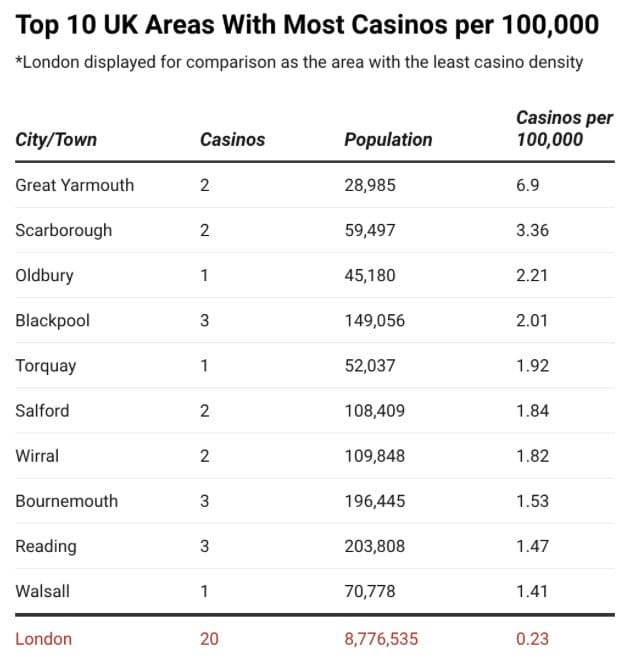
At the top of the rankings is Great Yarmouth, which records the highest casino density in Britain. With two casinos serving a population of fewer than 29,000 people, the town has 6.9 casinos per 100,000 residents – more than triple the rate of any major UK city.
Scarborough ranks second, with 3.36 casinos per 100,000 people, followed by Oldbury (2.21), Blackpool (2.01) and Torquay (1.92). Together, these results highlight the outsized role played by coastal and leisure-oriented towns in Britain’s gambling landscape.
Other seaside destinations also feature prominently in the top half of the table. Wirral (1.82), Bournemouth (1.53), Southend-on-Sea (1.10), Brighton and Hove (1.08) and Portsmouth (0.90) all record casino densities well above the national average. The concentration of venues in these locations reflects the economic importance of tourism, nightlife and seasonal visitors in sustaining gambling infrastructure.
Smaller urban centres outperform major cities
Beyond coastal towns, several mid-sized and post-industrial urban areas also show unexpectedly high casino density. Salford (1.84) ranks ahead of many larger cities, while Walsall (1.41), Bolton (1.09) and West Bromwich (0.97) also place above the UK’s biggest metropolitan areas.
Nottingham (1.33), Hull (1.11) and Newcastle upon Tyne (1.05) further illustrate how regional cities can support a relatively high concentration of casinos despite modest population sizes.
These findings demonstrate how population scale plays a crucial role in shaping per-capita gambling presence. In smaller towns and cities, even a handful of venues can translate into a high casino density, while much larger cities appear comparatively underserved when measured per resident.
Casino Density in Wales: Swansea vs Cardiff
There is a clear divide in casino availability across Wales, with Swansea ranking as one of the lowest-density areas in the UK. The city recorded just one casino serving a population of 246,217, giving it a ratio of 0.41 casinos per 100,000 people. This places Swansea fourth from the bottom nationally, highlighting how limited its bricks-and-mortar casino presence is compared with other urban centres.
In contrast, the Welsh capital Cardiff showed a noticeably higher concentration. Cardiff recorded three casinos for a population of 362,310, producing a density of 0.83 casinos per 100,000 people – more than double Swansea’s figure.
London and the big city myth
Despite hosting around 20 casinos, London ranks last among the 40 locations analysed, with just 0.23 casinos per 100,000 residents. With a population approaching 9 million, the capital’s vast scale dramatically dilutes its per-capita casino footprint.
Manchester, often associated with nightlife and entertainment, records 1.06 casinos per 100,000 people, placing it mid-table rather than among the national leaders. Birmingham, the UK’s second-largest city, registers 0.45 casinos per 100,000 residents – less than half the density of towns such as Blackpool or Scarborough.
Other major cities follow a similar pattern. Leeds (0.56), Liverpool (0.59), Sheffield (0.80) and Bristol (0.71) all trail behind smaller towns and seaside destinations, reinforcing the idea that casino concentration is driven less by city size and more by tourism, demographics and local leisure economies.
What the data reveals about Britain’s gambling geography
The analysis shows that a combination of tourism, population scale and historical entertainment infrastructure shapes Britain’s casino landscape. Coastal towns, where visitor numbers often exceed resident populations, emerge as the country’s most casino-dense locations. Meanwhile, large cities with millions of residents appear comparatively sparse when viewed through a per-capita lens.
Taken together, the findings challenge the assumption that Britain’s gambling industry is dominated by its largest cities. Instead, the data reveals a more nuanced geography, in which seaside towns and smaller urban centres play a disproportionate role in hosting casino venues.
Underage gambling is an offence. You must be over 18 years old to gamble.
Any form of gambling should always be fun, playing in a way that is right for you. It’s good to set limits, take time out or set up reminders.
Please gamble responsibly and in moderation.
For more information on the tools available to help to keep you safe or if you want advice or support you can call the National Gambling Helpline on 0808 8020 133 (England, Scotland and Wales or visit Gamblingtherapy.org).
