

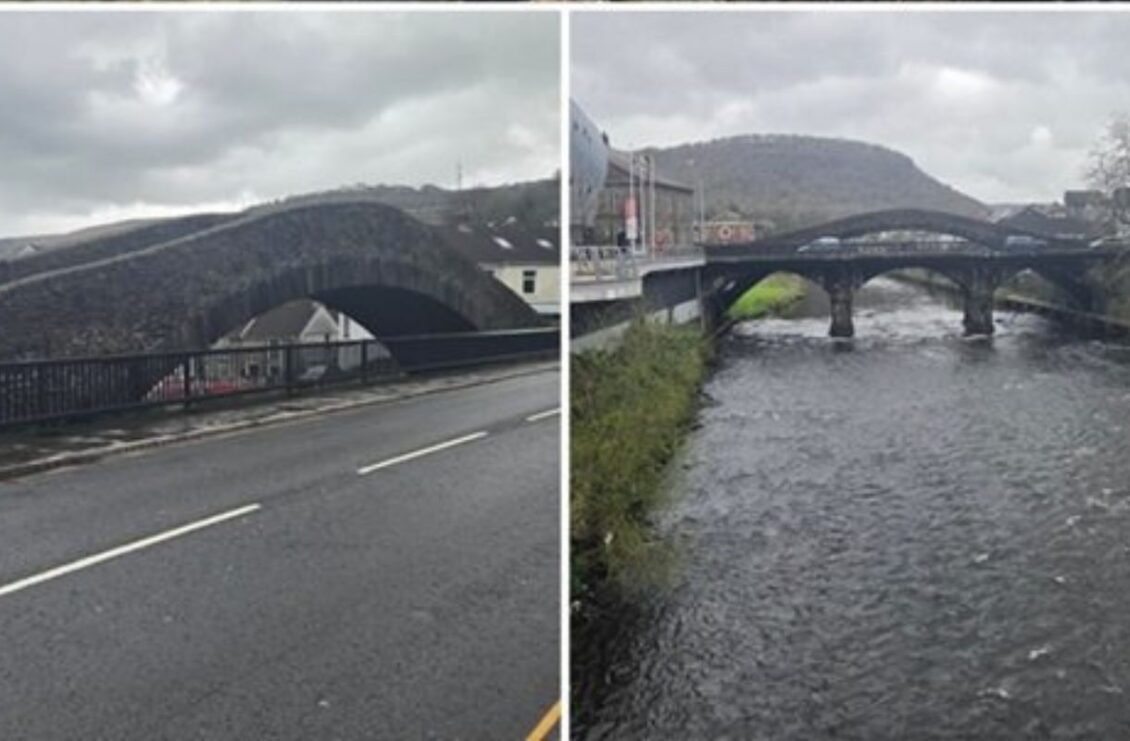
A historic bridge in Pontypridd is set to undergo a high-tech survey using the same technology once used to explore Egyptian pyramids.
William Edwards Bridge will be examined by Rhondda Cynon Taf Council using muon tomography, a cutting-edge, non-invasive technique that allows engineers to see inside structures without causing damage.
The work marks one of the first times the technology has been used on a bridge and aims to build a clearer understanding of the structure’s internal make-up. The bridge, built in 1756, is a Scheduled Ancient Monument and one of Pontypridd’s most recognisable landmarks.
Historical records suggest there could be hidden voids within the bridge, beyond the six circular holes visible today. The survey will help confirm whether these spaces exist and provide insight into how the structure was originally built, supporting future conservation efforts.
The survey is due to take place over five days from the week commencing Monday, April 13. During this period, specialist detectors will be placed beneath the bridge soffit for two days at a time before being repositioned.
To protect the structure, a specially designed cradle will be used to support the equipment, resting on the parapet with soft timber lining to prevent damage to the stonework. The bridge will be temporarily closed while the survey is carried out, with fencing installed to secure the site. An adjacent footway will remain open, although slightly narrowed.
Muon tomography works by detecting naturally occurring particles known as muons, which fall to Earth from space. By measuring how these particles pass through the bridge, engineers can estimate the density of materials inside, effectively allowing them to identify hidden voids or unusual features without drilling or excavation. The process does not produce radiation.
The technology has previously been used to investigate Egyptian pyramids, volcanoes and underground tunnels, and is now being applied in Pontypridd to uncover new details about the historic structure.
A spokesperson for Rhondda Cynon Taf Council said: “William Edwards Bridge is a really special part of Pontypridd’s history, and this survey gives us a rare opportunity to learn more about it while treating it with the care it deserves.
“What is particularly exciting about this work is that it allows us to look inside the bridge without causing damage to the stonework. For a structure of this age and importance, that is a huge step forward.
“We want this bridge to be protected not just for today, but for future generations too. The more we know about how it was built and what is happening inside it, the better placed we are to look after it for many years to come.”
William Edwards Bridge is expected to reopen by Friday, April 17.
