

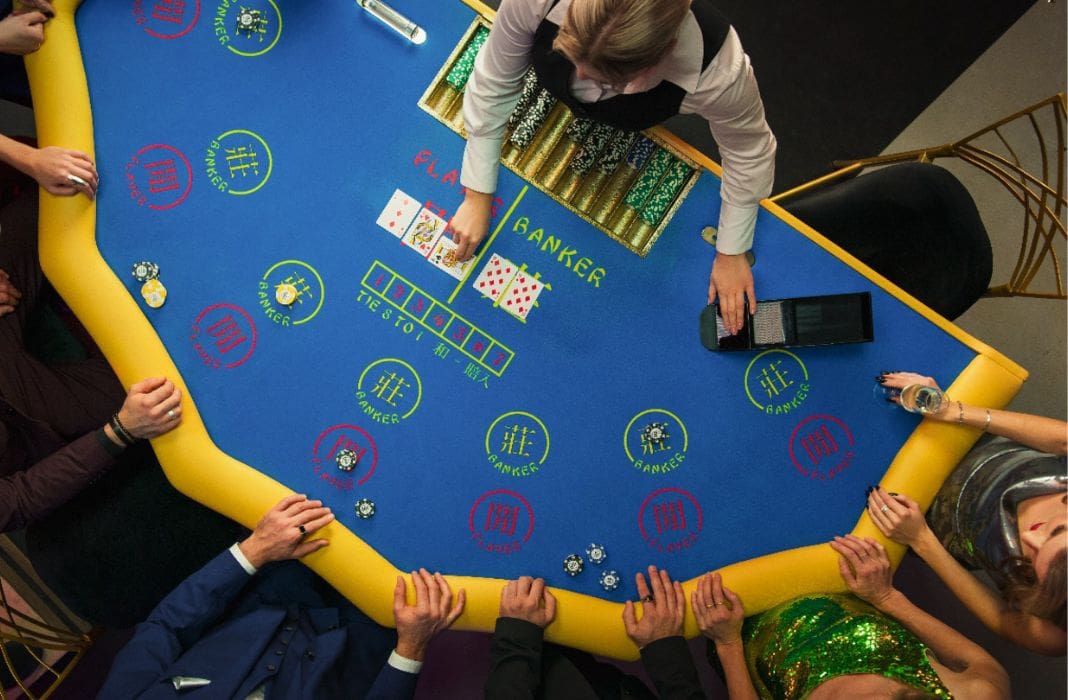
Baccarat is the simplest game on any casino floor to play and one of the harder ones to explain, because almost nothing about it is left to the player. A Punto Banco table in an online casino at BETDAQ offers three bets and no decisions after that. The cards are dealt according to a fixed table of rules, the hands play themselves, and the house edge on each of the three options is a published figure.
How a coup is dealt
A coup is one round. Two cards go to the player hand and two to the banker hand, and those names describe the two hands rather than the two sides of the table. Anyone at the table may bet on either.
Cards score at face value, with tens and court cards counting zero and the ace counting one. Only the final digit of a total matters, so a seven and a six make three rather than 13. Nine is the best total available.
The drawing rules are automatic
If either hand totals eight or nine on the first two cards, that is a natural and both hands stand. Otherwise the player hand draws on a total of zero to five and stands on six or seven.
The banker hand then follows a longer table that depends on its own total and, where relevant, the value of the card the player hand drew. No table requires a player to know it, because the dealer or the software applies it and no choice is involved.
The banker bet
The banker hand wins slightly more often than the player hand, because it acts second and draws with information the player hand did not have. Across all coups in an eight-deck game it wins about 45.9% of the time against roughly 44.6% for the player hand.
That advantage is priced. A winning banker bet pays even odds less a 5% commission, which leaves a house edge of about 1.06%, the narrowest figure on the table. Some tables remove the commission and instead pay only half on a banker win with a total of six, which raises the edge to about 1.46%.
The player bet
A winning player bet pays even odds with no commission, and its house edge is about 1.24%. The gap between the two main bets is therefore fractions of a per cent, and both are among the thinnest margins available in a casino.
The tie bet
Ties occur in roughly 9.5% of coups. Paid at 8:1, the tie bet carries a house edge of about 14.36%, more than 10 times the cost of either main bet. A table paying 9:1 reduces that to about 4.84%, which is still several times the price of backing a hand.
Pair bets and other side wagers on baccarat tables are priced on the same principle. Every one of them costs more per unit staked than the bet it sits beside, and the payouts are listed in the rules panel.
Progression systems and what they cannot change
Baccarat attracts more pattern tracking than any other casino game. Result histories are displayed as grids, and the tradition of reading them dates back decades.
Named progression systems such as the Martingale, which doubles a stake after a loss, are recognised methods with long histories. None of them changes the house edge or the probability of any coup, because each deal is independent of the one before it. What a progression alters is the shape of the stakes, not the arithmetic underneath.
Before a session
Baccarat moves quickly, often at 40 or more coups an hour online, so a thin edge is applied many times in a short period. Read the commission rule, the tie payout and the table limits before sitting down, and set a deposit or time limit at the same time. Gaming is for over-18s, and licensed operators list free responsible gaming support.
Underage gambling is an offence. You must be over 18 years old to gamble.
Any form of gambling should always be fun, playing in a way that is right for you. It’s good to set limits, take time out or set up reminders.
Please gamble responsibly and in moderation.
For more information on the tools available to help to keep you safe or if you want advice or support you can call the National Gambling Helpline on 0808 8020 133 (England, Scotland and Wales or visit Gamblingtherapy.org).
