

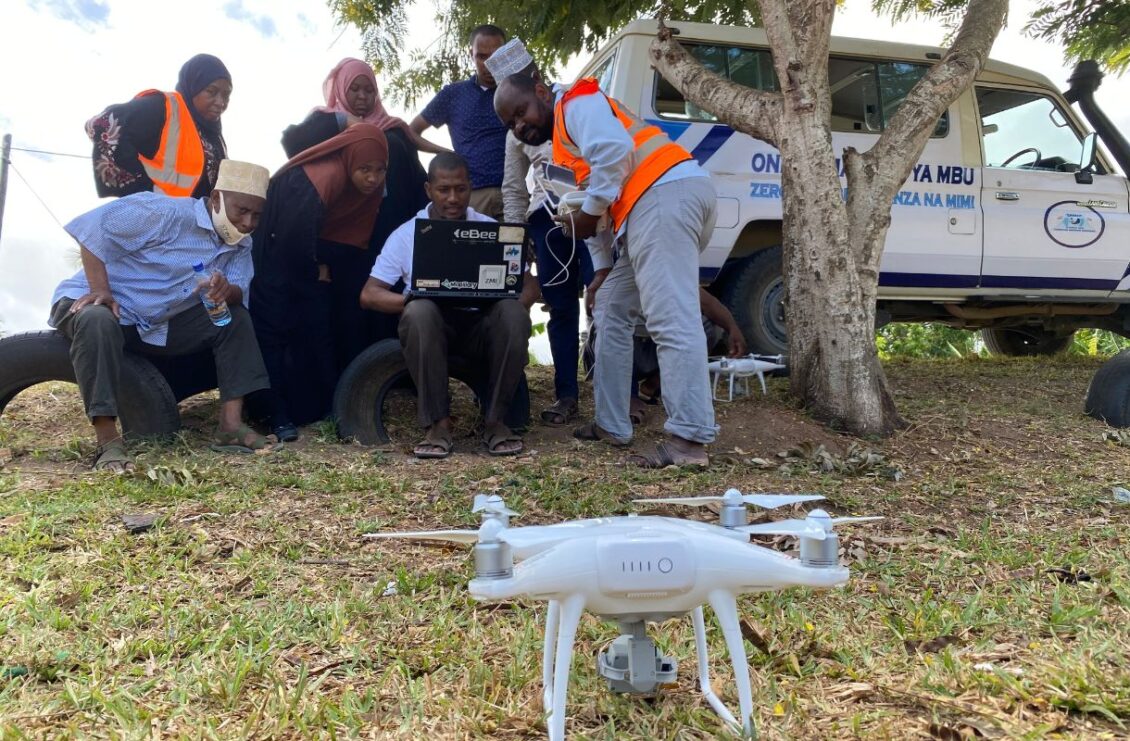
Drones and AI will be used in a new £2.5 million Aberystwyth University-led effort to wipe out malaria hot spots in Africa, supported by funding from the Gates Foundation.
Malaria is one of Africa’s most devastating public health challenges, causing hundreds of thousands of preventable deaths each year.
A new international research project in Zanzibar, led by Aberystwyth University, will target the aquatic habitats of mosquito larvae before they mature.
The project will exploit the latest drone, satellite and artificial intelligence technology to help identify these sites more effectively. It builds upon success in previous projects that used smartphones and drones.
The initiative brings together researchers, public health experts, and community stakeholders to develop sustainable, locally-led strategies for mosquito control, supported by funding from the Gates Foundation.
The research team will overcome the limitations of conventional mapping by using drones equipped with advanced sensors – including near-infrared and thermal imaging – to tackle challenges such as water hidden by dense vegetation. Satellite imagery will also be used to map larger water bodies. The combination of these technologies will enable mosquito habitat mapping over a large area without requiring extensive fieldwork.
Artificial intelligence will be trained to analyse the images and accurately find mosquito breeding grounds, even in complex or obscured environments like rice paddies or swamps with thick aquatic vegetation or algae cover.
Key software developed by the project will be open source, with the ultimate goal being to create a transferable and scalable model for malaria-hit regions worldwide.
Dr Andy Hardy, lead researcher from Aberystwyth University’s Department of Geography and Earth Sciences, said:
“This project is reinventing mosquito control in a bid to tackle one of sub-Saharan Africa’s most urgent public health challenges. By using drones, satellite imagery, and AI, we can rapidly and precisely map breeding grounds, making interventions more targeted and effective.
“Our focus on the ecology of mosquito habitats and collaboration with local communities will help build a scalable, sustainable model that could serve as a blueprint for malaria control across the globe.”
In addition to technological innovation, the project will invest in community engagement, in order to overcome any concerns or resistance to the new technologies, and to train people in methods of eradicating mosquito larvae before they emerge from the water as adults.
The three-year project will create a digital toolkit to streamline mosquito control operations. It will feature a central dashboard for managers to plan and oversee activities, alongside a smartphone app that will help field staff to map, spray, and monitor tasks.
The system will recommend the most effective way to map an area based on terrain and budget and include guidelines to support consistent and effective implementation.
Dr Shija Joseph Shija from the Zanzibar Malaria Elimination Program which is collaborating on the project, said:
“Zanzibar has made tremendous progress in the fight against malaria, yet we continue to face the persistent challenge of mosquito breeding sites that are often difficult to detect and control. This new £2.5 million initiative, led by Aberystwyth University and supported by the Gates Foundation, represents a powerful step forward in our efforts to eliminate malaria from our islands.
“We are particularly encouraged that the tools and software developed through this project will be open source. This means Zanzibar will be among the first regions globally to benefit from a fully transferable, data-driven model that can support real-time planning, monitoring, and decision-making in larval source management.”
Other partners on the project include the London School of Hygiene & Tropical Medicine, Liverpool School of Tropical Medicine, Ifakara Health Institute in Tanzania, and Zzapp Malaria.
