

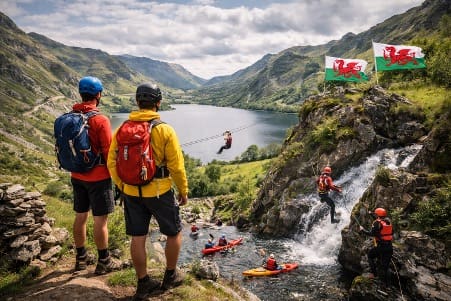
A few years ago, a walking guide based in Llanberis told a journalist something that stuck. He said the strangest thing about his job was how often clients arrived and seemed genuinely surprised that Wales existed. Not geographically — they knew where it was. But they had no idea what was actually there. They booked because a friend mentioned it, or they found a trail on an app, and then they showed up and couldn’t quite believe what they were looking at. That gap — between perception and reality — is probably the most honest explanation for why Welsh outdoor tourism has grown so sharply. Not marketing. Not government strategy. The place was there all along. People just stopped assuming it wasn’t worth the detour.
There’s a pattern that shows up across outdoor travel now, whether someone is planning a route through the Carneddau or deciding which casinacho casino to try on holiday — people research obsessively before they go. Forums, GPS files, condition reports, reviews from three years ago. That shift in how trips get planned worked in Wales’s favour. Once the trail infrastructure was searchable, bookable, and reviewable, the visitors followed.
What the numbers actually say
Wales has three national parks: Eryri (Snowdonia), Bannau Brycheiniog (Brecon Beacons), and Pembrokeshire Coast. Together they cover about a fifth of the country. Combined annual footfall across the parks exceeds 12 million visitors. Tourism sustains over 86,000 jobs directly and accounts for roughly 10% of Welsh employment. The sector’s contribution to the economy sits at around £5 billion a year.
Those figures are solid, but the outdoor activity slice is what’s growing fastest. Research by the Wales Adventure Tourism Organisation found that climbers, hill walkers, and surfers generate economic returns that outpace standard leisure tourism — they stay longer, spend more per day, and come back. A visitor who drives to a castle, takes a photo, and leaves generates less than one who books three nights near a trailhead, hires a guide, eats locally, and needs kit repairs.
North Wales had a particularly strong 2024. The Great Britain Tourism Survey placed it among the top-performing domestic destinations in a year when the UK recorded 1.1 billion domestic trips. Wrexham County alone pulled in 2.07 million visitors, with tourism worth £191 million to the local economy — and that was before the full Wrexham AFC effect had worked its way through hospitality bookings.
The Wales Coast Path changed something fundamental
In 2012, Wales opened a continuous coastal walking route stretching 870 miles from the Dee Estuary to the Severn. It was the first of its kind anywhere in the world. Before it existed, the coast was a collection of disconnected sections, some well-maintained, others not. After it opened, it became a product — something you could plan a holiday around, break into manageable stages, track progress on.
The path did something else, too. It gave outdoor media a story. Walking magazines, YouTube channels, Instagram accounts — they all needed routes to cover, and suddenly Wales had one that ran the length of the country. Pembrokeshire had already built a reputation around the 186-mile coastal section, and coasteering — that combination of cliff jumping, swimming, and scrambling that Pembrokeshire claims to have invented — had been drawing activity tourists for years. The full Wales Coast Path amplified all of that.
Snowdonia had its own turning point. The Slate Landscape of North West Wales became a UNESCO World Heritage Site in 2021. That designation doesn’t just put a place on a list — it changes how international travel media covers it, which changes where certain types of visitors look first. The slate quarries that had been adventure playgrounds for local mountain bikers became part of a story about industrial history and landscape recovery. Zip World, built inside Penrhyn Quarry and home to what is described as the world’s fastest zip-line, draws visitors who would never self-identify as hikers.
Outdoor activity sectors by region
| Hiking & trail running | Eryri (Snowdonia) | Yr Wyddfa summit, 90+ named routes, winter conditions from October |
| Mountain biking | Mid Wales, Brecon Beacons | 800+ miles of graded trail, dedicated bike parks, less crowded than Peak District |
| Coasteering | Pembrokeshire | Claimed origin of the sport, licensed operators, 186-mile coast path |
| Stargazing | Bannau Brycheiniog, Elan Valley | International Dark Sky Reserve + Gold Tier status, guided astronomy stays |
| Sea kayaking & wild swimming | Wales Coast Path corridor | Accessible launch points, tidal variety, relatively uncrowded sea |
| Aerial & zip-line | North Wales (Penrhyn Quarry) | Velocity 2 cited as world’s fastest zip-line; slate quarry setting |
Dark skies and the off-season problem
One of the more quietly significant developments in Welsh outdoor tourism was Bannau Brycheiniog receiving International Dark Sky Reserve status. Elan Valley, in Mid Wales, later added Gold Tier accreditation. Neither of these headlines makes the front page anywhere. But in practical terms, they solved a problem that Welsh tourism had struggled with for years: November.
Stargazing does not require good weather in the conventional sense. It requires darkness and clear nights, which the Welsh uplands provide more reliably in autumn and winter than in the tourist season. Hotels and self-catering operators in the Beacons and Elan Valley now sell guided astronomy weekends with telescope hire. Those bookings fill beds during months when rooms previously sat empty. That’s not a trivial economic shift for rural businesses operating on thin margins.
The 2024 Visit Wales consumer tracker found something telling. The proportion of visitors citing ‘connecting with nature or being outdoors’ as their main reason for choosing Wales increased compared to 2023. The same increase did not show up in surveys for other UK destinations that year. Wales was pulling ahead on that specific motivation — not just benefiting from a general bump in domestic travel.
Where the growth is uneven
South Wales had a different 2024. Taylor Swift concerts and major internationals at the Principality Stadium lifted Cardiff accommodation numbers, and some of that spending spilled into the Wye Valley and the valleys immediately north of the city. But the broader South West saw a significant drop in visitor footfall. Businesses in that area reported that visitors with less disposable income were either not coming or shortening their stays. The cost of living hit some areas harder than others, and Welsh tourism is not one monolithic story.
The split matters because it shows the limits of headline growth figures. When 40% of Welsh tourism businesses reported more customers in 2025 than in 2024, that number looked encouraging. But 28% reported fewer. The outdoor activity operators — attractions, activity centres, guides — performed better than accommodation, with 50% of non-accommodation businesses seeing customer growth. That gap between sectors tells you something about where the real momentum sits.
Four things that still hold the sector back
Talk to anyone who runs an outdoor activity business in rural Wales and the same frustrations surface, regardless of which region or which activity:
- Public transport to trailheads is thin or nonexistent in most of rural Wales, which means visitors arrive by car, park in the same three car parks, and create exactly the congestion that makes the experience worse for everyone
- Mid-range accommodation — something between a tent and a boutique hotel — is genuinely scarce in areas where trail infrastructure is strongest, pushing multi-night visitors toward self-catering or long drives back to larger towns
- Trail condition reporting varies wildly by area; some paths have live GPS data and maintenance logs online, others have no digital presence at all, which makes planning harder and leads to disappointed visitors who arrived expecting a different experience
- The outdoor season still concentrates heavily in June through August, partly because the shoulder months lack the same marketing support, and partly because school holidays drive family bookings regardless of what the weather is doing in October
What the growth actually rests on
Strip away the strategy documents and the tourism board language, and what drove Welsh outdoor tourism growth comes down to something simpler. A section of the British and European travel market stopped wanting resorts. They wanted places where the point of the trip was the physical effort — the climb, the paddle, the night in a field with a clear sky above it. Wales had the terrain for all of that and, for a long time, did not have the infrastructure or the reputation to match.
The infrastructure came first: the coast path, the trail networks, the activity centres. The reputation followed, slowly, through the channels that actually move travel decisions now — YouTube videos of mountain bike descents, Instagram routes, trail apps with offline maps. Wales did not need to convince anyone that mountains and coastline were appealing. It needed to make them findable, bookable, and worth the planning effort.
That has largely happened. The question now is whether what exists can absorb continued growth without losing the thing that made it worth going to in the first place. Parking, footpath erosion, overtourism in the most photographed spots — these are not hypothetical concerns in Eryri. They are current problems with finite solutions. The sector’s next challenge is less about attracting visitors and more about what happens after they arrive.
