

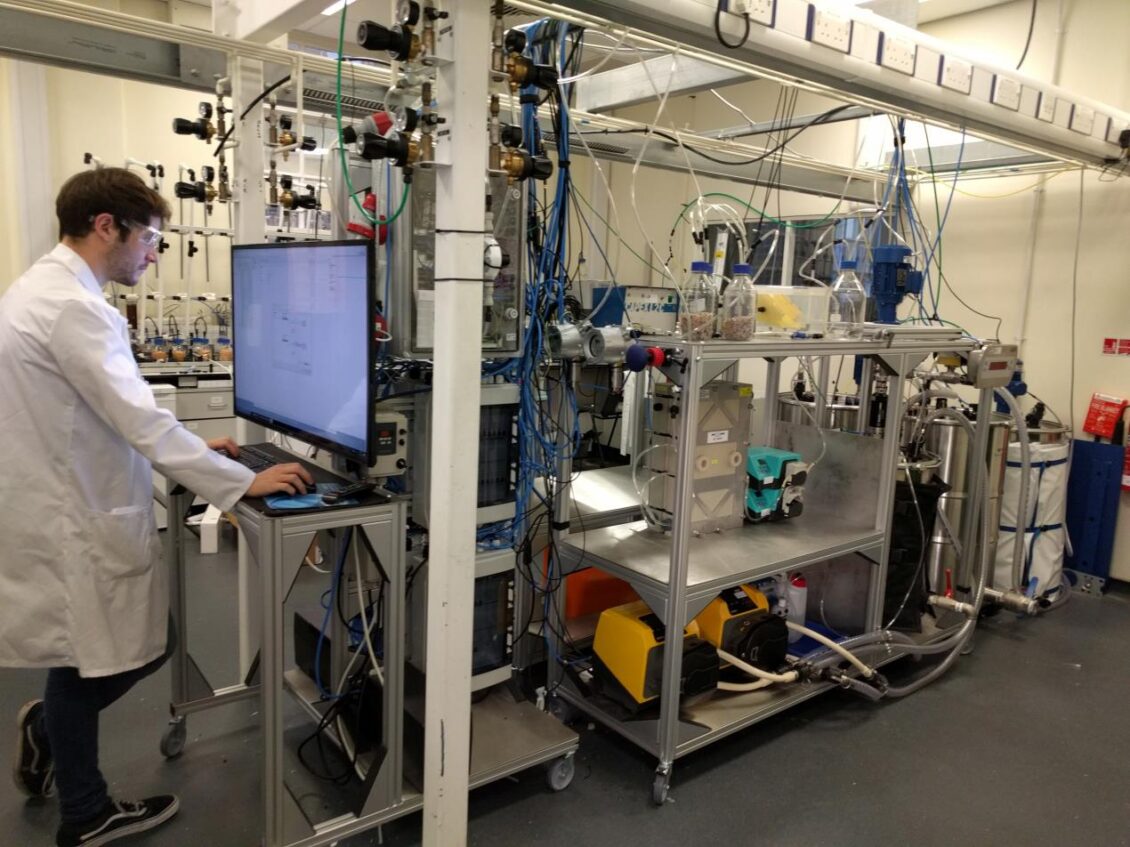
A University of South Wales (USW) academic has become one of the first ever Royal Academy of Engineering Green Future Fellows, and will be one of 13 engineering innovators to receive £3 million each to develop solutions that tackle multiple causes of the climate crisis, and mitigate and adapt to its impacts.
Dr Jaime Massanet-Nicolau, Associate Professor of Bio-Based Chemical Production at the USW-based Sustainable Environment Research Centre (SERC), will lead the team which will benefit from part of the £150 million long-term investment from the Department for Science, Innovation and Technology. The team will include Professor Alan Guwy and Dr Rhys Jones, who bring a wealth of experience and expertise in biorefining to the project.
The 13 Green Future Fellows have been awarded funding to scale ambitious ideas and cutting-edge engineering over the next decade into commercially viable technologies capable of making a lasting impact on the climate crisis.
The project Dr Massanet-Nicolau will lead – BIO-VISTA – aims to tackle one of the biggest challenges facing UK and global industry: how to reduce reliance on fossil-based chemicals while cutting carbon emissions.
BIO-VISTA will develop biotechnology capable of converting many types of waste materials into volatile fatty acids (VFAs) – extremely versatile building-block chemicals used in plastics, textiles, pharmaceuticals, animal feed, wastewater treatment, and emerging green technologies such as bio-plastics. The global VFA market is worth around £10 billion a year and is growing.
“Today, most organic chemicals come from oil and gas, and the chemical sector produces around 6% of global greenhouse gas emissions,” Dr Massanet-Nicolau said.
“At the same time, huge amounts of waste, from food residues to sewage sludge and industrial off-gases, contain carbon that is largely unused.
“BIO-VISTA’s vision is simple: turn this waste carbon into high-value, sustainable chemicals that industry already needs, and create a circular economy where waste becomes a resource instead of a problem.”
Starting next year, the BIO-VISTA project will bring together key innovations to reduce energy use and increase efficiency, improve VFA yield, and define the economic and environmental benefits of this low-temperature biorefining technology. This will help optimise processes to convert wastes into valuable chemicals; develop new reactors and chemical recovery systems; build pilot-scale systems at the University and partner sites; support industry understanding of the BIO-VISTA process; and develop commercial opportunities to ensure the research delivers real-world impact.
“We are working with Welsh Water and Severn Trent, giving us access to real wastewater streams and operational insight for future pilot deployment, as well as dairy co-operative First Milk to explore agricultural and food-processing residues as viable feedstocks,” Dr Massanet-Nicolau added.
Professor Alan Guwy, Head of the Sustainable Environment Research Centre, said:
“BIO-VISTA builds on the VFAFactory concept we have developed at SERC over many years with Jaime Massanet-Nicolau and Rhys Jones. Jaime’s Royal Academy of Engineering Green Future Fellowship is a fantastic recognition of the ambition and impact of this work, and will help translate our research into deployable, low-carbon chemical technologies.”
Other projects awarded Green Future funding include those focused on more efficient and recyclable solar panels; extracting critical metals for batteries, magnets, solar panels and fuel cells by filtering salty water; long-term renewable energy storage; and more energy-efficient data storage systems.
There is also work underway on a new type of battery that is four times more energy-dense, the use of sound waves to destroy “forever chemicals” in water and soil, and the application of specialist microbes to convert carbon dioxide into clean hydrogen.
Professor Louise Bright, Pro Vice-Chancellor for Enterprise, Engagement and Partnerships, Research and Innovation at USW, said: “BIO-VISTA develops technology, talent and partnerships that strengthen USW’s research profile and industrial reputation.
“By combining scientific innovation with real-world deployment potential, it creates opportunities for students, researchers and future commercial activity.”
Baroness Brown of Cambridge, Fellow of the Royal Academy of Engineering and Chair of the Green Future Fellowship Steering Group, said:
“The climate crisis is the challenge of our generation. We need era-defining solutions that address the enormity of the challenge. Many of these solutions exist, but need the dual investment of money and time to make them a success.
“The Green Future Fellowships support innovators who are pushing engineering boundaries and developing bold solutions to climate change mitigation, adaptation and resilience. The inaugural Green Future Fellows are pioneering truly advanced technologies to protect the world we live in.”
