

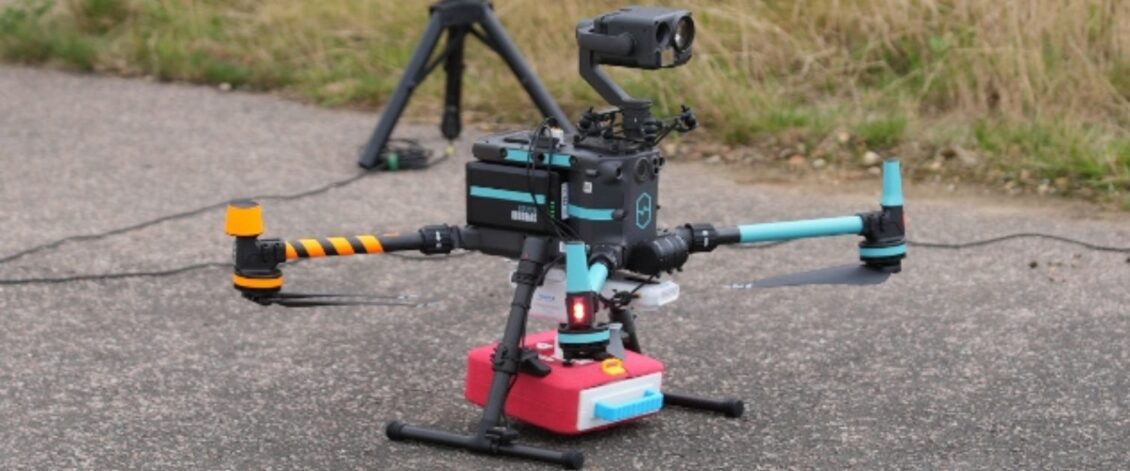
The idea of drones delivering defibrillators to people suffering a cardiac arrest in the UK has moved a step closer to becoming reality.
Researchers funded by the National Institute for Health and Care Research (NIHR) have carried out pioneering tests using drones to respond to 999 calls during emergency simulations.
The University of Warwick worked with the Welsh Ambulance Services University NHS Trust and drone specialists SkyBound on the project, which saw defibrillators flown to a training exercise in a remote countryside location where road access would usually delay ambulance crews.
The study, known as The 3D Project, has been published in the journal Resuscitation Plus. Researchers believe it could pave the way for the technology to be used in real-life emergencies and eventually rolled out across the NHS.
Cardiac arrest happens when the heart suddenly stops beating, causing a person to fall unconscious and stop breathing. More than 40,000 out-of-hospital cardiac arrests occur in the UK each year, but survival rates remain below 10%.
Early CPR and the use of an Automated External Defibrillator (AED) can double the chances of survival. AEDs are safe for members of the public to use, even without training, but they can be difficult to find in an emergency.
To tackle this, researchers created a system that uses a DJI M300 drone equipped with a winch to deliver an AED following a 999 call. The drone, controlled by SkyBound’s automated software, flew to the scene and lowered the device to a bystander, who was guided by ambulance call handlers to perform resuscitation on a CPR mannequin.
The trial involved 11 participants, with researchers monitoring communication between the drone pilot, call handler and bystander, as well as recording how quickly the AED reached the simulated patient.
Chief Investigator Dr Christopher Smith, from the University of Warwick, said: “Ambulance services work as swiftly as possible to get to patients who have suffered cardiac arrests.
“However, it can sometimes be difficult to get there quickly.
“AEDs can be used by members of the public before the ambulance gets there, but this rarely happens.
“We’ve built a drone system to deliver defibrillators to people having cardiac arrest which could help save lives.
“We have successfully demonstrated that drones can safely fly long distances with a defibrillator attached and maintain real-time communications with emergency services during the 999 call.
“We are in a position where we could operationalise this system and use it for real emergencies across the UK soon.”
The study’s findings suggest the technology is highly promising.
The drone was able to fly autonomously and safely, while maintaining strong communication links with the ambulance service. Participants also responded positively to the arrival of the defibrillator.
Key timings from the trial included:
-
2.18 minutes from the emergency call to drone take-off
-
A further 4.35 minutes after the drone’s arrival before a shock was delivered to the simulated patient
-
2.32 minutes of hands-off CPR, with just 0.16 minutes of this spent retrieving the AED
Bystanders were able to collect the AED safely and worked well with the drone, but many struggled to operate the defibrillator itself. Researchers concluded that both bystanders and call-handlers would need more support to use drone-delivered AEDs effectively.
In a separate part of the study, the team interviewed people who had previously performed CPR or used an AED during a cardiac arrest. They were asked for their views on drones delivering defibrillators and the challenges they expected in real situations.
The next step will be securing funding for larger trials to explore how the system could be integrated into NHS services.
Similar schemes are already in place in Denmark and Sweden, where drones are used in certain cases to deliver defibrillators.
Professor Mike Lewis, NIHR Scientific Director for Innovation, said: “Cardiac arrest, as the Secretary of State highlighted, is one of the biggest killers, claiming tens of thousands of people’s lives a year.
“In an emergency situation, time is of the essence and it’s crucial that bystanders can help before ambulance crews arrive.
“That’s why it’s so exciting this innovative study is investigating if emergency services can harness drones to deliver defibrillators to help improve survival.
“This demonstrates how health and care research can deliver high tech solutions to improve health and care services, and powers the country’s life sciences sector and technical advantage.”
Carl Powell, Clinical Lead (Acute Care) at the Welsh Ambulance Service, said: “In a cardiac arrest, every second counts.
“We will always send an ambulance as quickly as possible, but starting chest compressions and delivering an electric shock with a defibrillator in the meantime could mean the difference between life and death.
“We’re grateful to NIHR and others for funding this research, which has demonstrated that the technology shows a great amount of promise.
“We’ll continue to work with partners to further explore and test how drone-delivered defibrillators could be harnessed by the NHS.”
Gemma Alcock, CEO of SkyBound, said: “This collaboration represents a significant step forward in leveraging technology to potentially save lives, particularly in remote areas where access to defibrillators can be challenging.
“Our involvement underscores the very reason SkyBound came into fruition, as the initial inspiration came from the experience I gained as a beach lifeguard where I dealt with a life-critical incident.
“This was the foundation of our commitment to harnessing innovative drone solutions to enhance emergency response and ultimately, save lives.”
Health Minister, Stephen Kinnock, said: “I want Britain at the forefront of this technological revolution to transform patient care.
“Drone-technology has the potential to help reach patients faster, especially in rural communities.
“This government is backing our country’s leading scientists to research, test, and develop new forms of emergency healthcare which have the potential to save lives.
“From AI helping doctors diagnose illnesses faster to drones delivering vital medical supplies, we will capitalise on innovation to transform care, reduce waiting times, and save more lives across every community in Britain.”
