

UK’s renters are under less pressure, with the lowest level of competition for rented homes in six years. The result is rents for new lets increasing by just 1.9% over the last year , according to Zoopla’s latest Rental Market Report.
Competition eases as demand falls
Demand amongst renters has fallen by 14% over the last year while the number of homes available for rent has increased by 11% over the same period.
The result has been less competition between renters with 4.8 enquiries per property, down from 6.5 a year ago. This is clear evidence of the rental market becoming more balanced after a peak in competition for rented homes seen in 2022 and 2023.  Improving conditions in the mortgage market for first time buyers and a continued decline in migration into the UK for work and study are the primary drivers of lower demand for rented homes. The latest ONS estimates reveal net migration into the UK peaked at 944,000 people in the year to March 2023 and this has slowed to 204,000 in the year to June 2025.
With three-quarters of first time buyers coming out of the rental market, more favourable conditions in the mortgage market have boosted first time buyer numbers, reducing demand for rented homes. This has helped to free up the number of homes for rent which explains the growth in supply.
However, the shift is not purely down to first-time buyers, with this increase also stemming from would-be sellers deciding to place their properties into the rental market – particularly if they are struggling to sell.
The changing dynamics of supply and demand also mean that homes are taking longer to rent. On average, finding a tenant now takes 20 days – a week longer than 2022’s peak of 13 days. For renters, this provides more choice of properties and more room for negotiation
Earnings rising faster than rents for 18 months
Less competition for rented homes has slowed rental growth for new lets to 1.9% over the last year, down from 2.9% a year ago. Average earnings have continued to increase at a faster rate than rents for the last 18 months which is also helping to improve affordability for renters.
The annual rent for the average property outside of London is now 33.5% of the gross annual income for a single person. This is an improvement from 2023 where the ratio was highest in 20 years at 35%.
North vs South divide in rental growth
Rental growth remains stronger in the more affordable markets in Northern England and Scotland, with certain cities seeing increases of 3%-4%+, as demonstrated by Liverpool and Newcastle recording growth of 4.6% and 4.5% respectively.
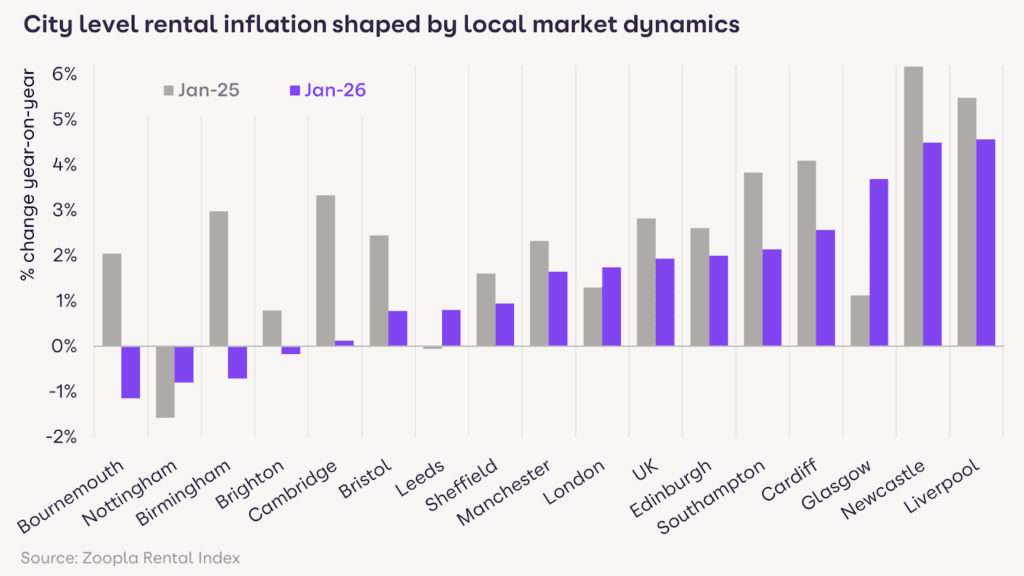
In contrast, several cities across the Midlands and Southern regions are seeing lower or even negative price growth, with Bristol growing at 0.8%, Cambridge at just 0.1%, and the likes of Birmingham (-0.7%) and Nottingham (-0.8%) actually falling. In London, rents are growing at a relatively low 1.7%, with the average rent now sitting at £2,187.
The data also reveals bigger fluctuations by region in terms of price growth, with Wales seeing a drop of -1.7% YoY from 4% to 2.3%, while the West Midlands region has fluctuated even more from 3.8% last year to 0.3%. This low growth reflects weaker rental demand in these areas, but is predicted to be short term, as local markets adjust to more balanced conditions.
Richard Donnell, Executive Director at Zoopla, said: “Market conditions for renters are the best they have been for 6 years.. The rental market is moving back towards balance as demand cools and more homes become available to rent. Renters are facing less competition for homes and slower rent increases than in recent years. Localised changes in demand and supply are resulting in rents falling in some cities but this will be only a short lived trend.
The rental market is moving back towards balance as demand cools and more homes become available to rent. Renters are facing less competition for homes and slower rent increases than in recent years.
However, supply remains well below pre-pandemic levels, which means increasing the number of rental homes remains key to improving affordability for the UK renters over the long term.”
Harry Watts, Lettings Director at London agent Douglas & Gordon said: “We’re seeing a more mixed picture on the ground in Central and South West London. While the market has become more balanced compared with the 2022–23 peak, applicant registrations are still up 18% so far this year versus the same period last year, which points to continued underlying demand for well located, good quality homes.
“At the same time, as we move closer to the Renters Reform Act, we’re seeing more tenants being asked to move at points in the year when they would not typically expect it. In many cases, this appears linked to landlords reassessing their position and, in some instances, choosing to sell, which is becoming more prevalent.
“And even where rental growth is cooling, there is a clear affordability ceiling. Over the past couple of years, tenant incomes have struggled to keep pace with pricing, so correctly priced homes let well, while anything ambitious is taking longer and facing sharper negotiation.”
