

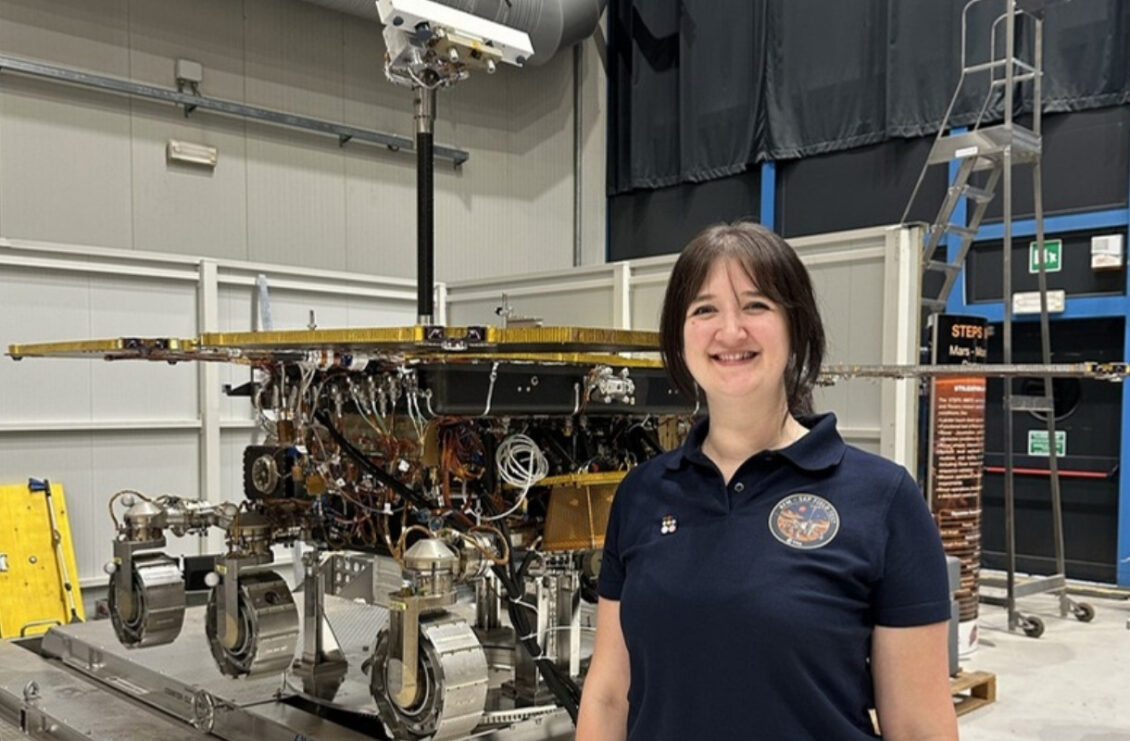
Technology developed at Aberystwyth University is being tested in Spain’s Tabernas Desert as part of trials for the European Space Agency’s ExoMars mission.
Researchers from the university’s Departments of Physics and Computer Science are supporting an exercise in which a prototype of the Rosalind Franklin rover is undergoing a series of trials ahead of the mission’s planned launch in 2028.
The Tabernas Desert, in the province of Almería in south-eastern Spain, is the only true desert in mainland Europe. Its arid climate, rugged landscape and rocky terrain allow technologies to be tested under Mars-like conditions.
The trial brings together scientists and engineers from across Europe to evaluate hardware, software and operational procedures before the rover begins its mission.
Aberystwyth University is involved in two pieces of hardware being developed for the mission: PanCam, a multispectral panoramic camera led by Mullard Space Science Laboratory at University College London, and Enfys, an infrared spectrometer led by Aberystwyth University.
During the mission, the two instruments will help scientists identify locations to search for evidence of past life. They are designed to detect minerals, including clays and other water-formed materials, that on Earth are known to preserve organic compounds.
The field trials use emulators, which mimic the real hardware without being space-qualified, so that testing can take place without risking flight hardware. Aberystwyth University is supplying two: the Aberystwyth University PanCam Emulator (AUPE) and an Enfys emulator.
Dr Helen Miles, a Senior Lecturer in Computer Science at Aberystwyth University, is supporting the development and validation of software used during the exercises, some of which will be used in the real mission for instrument control and data processing.
She said: “Exercises like these are a crucial step in preparing for planetary exploration missions. They allow us to evaluate technologies, software and operational procedures in a demanding environment that shares many characteristics with Mars.
“It’s exciting to see systems developed at Aberystwyth University contributing to an international mission of this scale. The knowledge gained through these exercises will help ensure the rover and its supporting technologies are ready for the challenges of operating on another planet.”
Postgraduate researcher Harry Marsh is part of the operations team. He said: “It’s incredibly rewarding to be involved in preparations for a mission that will search for signs of past life on Mars. From the Rover Operations Control Centre in Turin, we are sending commands and overseeing activities as they would be conducted during a real Mars mission, working closely with colleagues from across Europe to put the rover through its paces.”
Aberystwyth University researchers have been involved in the ExoMars mission for 15 years.
