

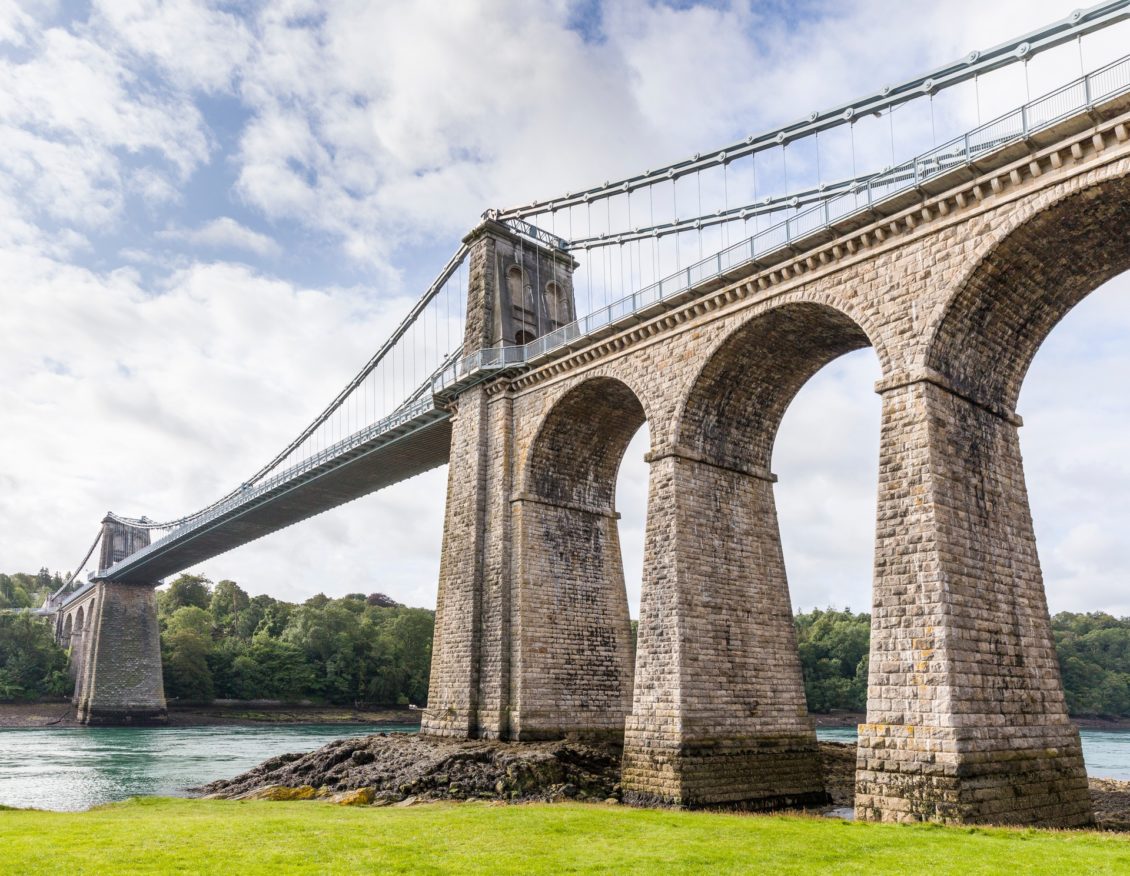
Development work on a third Menai crossing will restart immediately, and an 18-month study will look at road-based solutions for the M4 around Newport, the Welsh Government has announced.
Deputy Minister for Transport Mark Hooper set out the plans in the Senedd on Tuesday (6 October), alongside a programme of shorter-term measures for both routes.
The Welsh Government said its review of the Menai crossings confirmed that resilience remains the key challenge for communities, businesses and travellers on Ynys Môn and across north Wales when the crossings are restricted or closed.
The development work on a third crossing includes design work, environmental assessment, business case development and statutory approvals. The government will also continue to invest in managing, maintaining and operating the existing crossings, and will invest in resilience measures on the Britannia Bridge, including wind deflectors, variable speed limits and other operational improvements.
An option for three-lane tidal-flow operation on the Britannia Bridge will not be taken forward. A safety risk appraisal published by the Welsh Government found that adding a flexible lane would make the bridge less safe than it is now.

On the M4, the Welsh Government said its review found that congestion continues to cause unreliable journeys and disruption and that no single intervention can solve the problem on its own, but it has concluded that road infrastructure improvement is needed alongside other measures. A preferred roads-based option will be selected at the end of the 18-month study.
Over the next five years, a programme of shorter-term improvements will include renewal and maintenance of the motorway, a delivery plan to improve how it is operated and managed, targeted improvements to roads and junctions around Newport, and measures to improve freight resilience by making better use of alternative routes such as the A465.
The programme also includes support from Transport for Wales to accelerate delivery of Cardiff Parkway and Magor and Undy stations, improved access to Severn Tunnel Junction railway station, and better bus connectivity between Newport and Cardiff.
The M4 around Newport review, carried out by Arup for the Welsh Government and published alongside the announcement, assessed eight options. One would fully close junction 27 (High Cross) and close the east-facing slip roads at junction 26 (Malpas) and junction 25 (Caerleon). The report estimates it would cost £14 million, take two years to deliver and reduce M4 traffic by 3%, but says it would displace traffic onto local roads. It adds that the closures could be trialled first using temporary measures.
The report notes that in June 2019 Welsh Ministers decided not to proceed with a new motorway south of Newport, placing significant weight on its estimated £1.4 billion cost and its environmental impacts, particularly on the Gwent Levels Sites of Special Scientific Interest. The Welsh Government then set up the South East Wales Transport Commission, chaired by Lord Burns.
Mr Hooper said: “People want action, not endless discussion. They want reliable journeys, less disruption and confidence that Government is getting on with improving things and making a difference to people’s lives. And that’s exactly what we’re doing.”
“We will carry out an 18-month study to consider a range of road-based solutions for the M4 around Newport. Alongside that work, we are taking action to reduce peak-hour traffic by up to around one in ten vehicles. Every vehicle taken off the road helps on a motorway that is already operating at or beyond capacity at the busiest times.”
“People on Ynys Môn and across the north of Wales have waited a long time for greater certainty about the future of the crossings. Today we are setting out a clear way forward, with action to improve the resilience of the existing crossings while immediately beginning work to develop a third crossing.”
Derek Walker, the Future Generations Commissioner for Wales, said the Welsh Government’s transport plans must pass a future generations test.
He said: “Everyone in Wales should be able to get where they need to go – and we can support our economy at the same time as having clean air, thriving nature, equal opportunities and a healthy future for our children and grandchildren.”
“We cannot afford to go backwards on transport, particularly when a previous review into M4 congestion at Newport has already pointed towards more sustainable solutions.”
“People were promised better public transport when the M4 Relief Road was roundly rejected. While it’s positive to see commitments to better bus and rail services, those promises now need to be delivered at pace.”
“I am also extremely concerned that protecting and restoring our environment does not have the prominence it urgently needs and I call on Welsh Government to reassure people that any road building compromising valuable nature sites will be off the table.”
“A third Menai crossing that improves connectivity for people today must fulfil Wales’ legal obligations to future generations and I have written to the Cabinet Minister to ask how he has taken the Future Generations Act into account in today’s decisions.”
“Next steps on these complex transport issues must use what has already been learned from previous reviews, listen to the communities affected and look beyond the immediate pressures to the Wales we are creating for future generations and ensure this is a wise investment in 50 years’ time.”
Joshua Miles, Head of FSB Wales, said road projects must not get stuck in reviews.
He said: “For too long, businesses have been discussing these problems without seeing a clear route to delivery. The M4 and Menai Crossings are critical economic links for Welsh businesses, and it is encouraging to see a renewed focus on getting on with the job.”
“Our recent Big Small Business Survey found that 88% of firms rely on the private car for the success of their business, while 44% say road maintenance and quality impact their business and 41% are affected by the low frequency of public transport services.”
“Plans for a third Menai crossing are welcome, and Welsh Government should set out its timescales for delivery as soon as possible.”
“Looking again at a roads-based solution to the M4 around Newport is helpful, however proposed junction closures are a concern and could significantly impact on local businesses. They reflect a failure to deal with the issues around Newport over decades.”
“However, roads are only part of the picture. We also need to see the UK Government deliver on its commitment to rail investment between Cardiff and Bristol, following the recommendations of the Burns Review.”
“The key test now is delivery. We will be looking to the next Welsh Government budget for clear evidence that these commitments are being backed with the funding needed to turn long-standing discussions into real progress for Welsh businesses.”
Russell Greenslade, CBI Wales Director, said:
“Tackling the M4 handbrake on Welsh growth is an urgent priority for business after years of discussions about relief roads and little action, as businesses and motorists continue to suffer from traffic bottlenecks on the main route in south Wales.
“The business community will now be focussed on working with politicians to deliver solutions to the congestion. The new government must put its foot to the floor to ensure the M4 becomes a gateway, not a barrier to investment, jobs and prosperity for local communities.
“The government is also right to prioritise a third Menai crossing, giving Ynys Môn access to new investment in an area that, with the Wylfa nuclear reactor, will be at the heart of the UK’s clean energy future. Ageing infrastructure and bridge closures cannot continue to hold back North Wales’ growth ambitions that are dependent on reliable access to the A55, and onto North West England.
“The CBI will work together with government to translate these plans into bricks and mortar infrastructure to boost growth in the North and South Wales economies.”
